
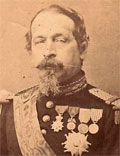
 |
Napoléon III b. 20 Apr 1808, Paris, France |
| Title: | Par la grâce de Dieu et la volonté nationale, Empereur des Français (By the Grace of God and Will of the Nation, Emperor of the French) |
| Term: | 1 Dec 1852 - 4 Sep 1870 |
| Chronology: | 1 Dec 1852, proclaimed Emperor of the French under the name of Napoléon III after the presentation of the results of a plebiscite on restoration of imperial dignity, public ceremony, galerie d'Apollon (grande galerie), Palais de Saint-Cloud [1] |
| 2 Dec 1852, sénatus-consulte of 7 Nov 1852 is promulgated and given the status of law, decree of the Emperor [2] | |
| 2 Sep 1870, ceased to exercise the functions of office upon capture by a belligerent force, near Sedan, France | |
| 4 Sep 1870, republic proclaimed in Paris by the Gouvernement de la défense nationale (Government of National Defence) [3] | |
| 1 Mar 1871, deposition confirmed, resolution of the National Assembly, session of the Assemblée nationale (National Assembly), Grand Théâtre, Bordeaux [4] | |
| Names/titles: | Prince [from 20 Apr 1808]; baptised (10 Nov 1810): Charles-Louis-Napoléon; semi-officially styled Prince-Président [from c. 1851]; used official signature Louis-Napoléon Bonaparte before 14 Jan 1852 and Louis-Napoléon between 14 Jan 1852 and 2 Dec 1852 [5] |
| Other offices: | Président de la République (President of the Republic) [20 Dec 1848 - 1 Dec 1852] (see details) |
| Biography: | |
| Third son of Louis Bonaparte, brother of Napoléon I and King of Holland (1806-1810), and Hortense de Beauharnais, stepdaughter of Napoléon I; left France with his family in 1815; attended a grammar school at Augsburg, Germany (1821-1823); was taught by private tutors; took part in an unsuccessful plot against the papal government in Rome (1830) and in the rebellion in central Italy (1831); attempted to win over the Strasbourg garrison for a coup d'état (30 Oct 1836); exiled to the United States (1837); returned to Europe (1837); expelled from Switzerland (1838), settled in England (1838-1840); landed near Boulogne with a group of supporters (6 Aug 1840), arrested and condemned to "permanent imprisonment" (6 Oct 1840); escaped from the fortress of Ham (25 May 1846); after the revolution of 1848 elected to the Assemblée nationale constituante (Constituent National Assembly); initially refused to take seat, but accepted second election (17 Sep 1848) and joined the Assembly (1848-1849); won the presidential election (10 Dec 1848) and was inaugurated (20 Dec 1848) as President of the Republic for the term ending on 9 May 1852; carried out a coup d'état of 2 Dec 1851; dissolved the Assemblée nationale législative (Legislative National Assembly) and held a plebiscite on the new constitution (20 Dec 1851 - 21 Dec 1851); promulgated constitution (14 Jan 1852) restoring universal suffrage and giving the president dictatorial powers; Sénat passed a sénatus-consulte (7 Nov 1852), proposing restoration of imperial dignity and proclamation of Louis-Napoléon Bonaparte as emperor under the name of Napoléon III; ensuing plebiscite (21 Nov 1852 - 22 Nov 1852) returned overwhelming majority of votes in favour of restoration of the Empire; accepted the imperial dignity at a meeting in the Palais de Saint-Cloud (1 Dec 1852); set up authoritarian regime relying on wide public support, which lasted until early 1860s when some liberal reforms were introduced; promulgated (21 May 1870) a constitution establishing liberal empire; surrendered and was taken prisoner (2 Sep 1870) in the course of war with Prussia; republic proclaimed in Paris (4 Sep 1870) by the Gouvernement de la défense nationale (Government of National Defence); National Assembly passed a resolution confirming the deposition of the emperor (1 Mar 1871); died in exile in England. | |
| Biographical sources: Dansette (1953) | |
| | |
| [1] | "Procès-verbaux des séances du Sénat. Année 1852. Tome Deuxième. Session extrairdinaire. - Du 4 novembre au 28 décembre. (Nos 18 a 26.)" (Paris: Imprimerie du Sénat et du Corps législatif, 1853), 83-90. |
| [2] | Bulletin des lois de l'Empire français. XIe Série. Tome premier (Paris: Imprimerie impériale: Juillet 1853). PP. 5-6, N° 1, n° 2: Décret impérial qui promulgue et déclare Loi de l'État le Sénatus-Consulte du 7 novembre 1852, ratifié par le Plébiscite des 21 et 22 novembre. |
| [3] | Bulletin des lois de la République française, XIIe série, 2e semestre 1870. Partie principale, T. 1, n° 1 (Paris: Imprimerie nationale, 1871): N° 1. - Proclamation au Peuple français. |
| [4] | Annales de l'Assemblée nationale, 1:105. |
| [5] | Bulletin des lois de la République française. Xe Série. Tome neuvième (Paris: Imprimerie nationale: Août 1852). P. 49ff. |
| Image: photograph by Mayer & Pierson, c. 1860. | |
Last update: 08 May 2025
Last update: 08 May 2025