 |
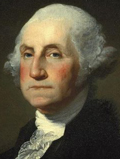
George Washington
b. 11/22 Feb 1732, "Wakefield", near Popes Creek, Westmoreland county, Virginia
d. 14 Dec 1799, Mount Vernon, Virginia |
| Title: |
President of the United States |
| Term: |
30 Apr 1789 - 4 Mar 1793 |
| Chronology: |
6 Apr 1789,
the election to the office of the President of the United States is declared upon the ascertainment and counting of the electoral vote (cast 4 Feb 1789), joint session of the Senate and House of Representatives, Federal Hall, Senate Chamber, New York City [1] |
|
14 Apr 1789, notified of election and accepts, Mount Vernon, Virginia; acceptance communicated to the Senate 25 Apr 1789, session of the Senate, Federal Hall, Senate Chamber, New York City [2][3] |
|
30 Apr 1789,
took the oath of office as the President of the United States, inaugural ceremony as part of the joint session of the Senate and House of Representatives, balcony in front of the Senate Chamber, Federal Hall, New York City [4] |
|
4 Mar 1793,
expiration of term [5] |
| Term: |
4 Mar 1793 - 4 Mar 1797 |
| Chronology: |
13 Feb 1793,
the election to the office of the President of the United States is declared upon the ascertainment and counting of the electoral vote (cast 5 Dec 1792), joint session of the Senate and House of Representatives, Senate Chamber, Congress Hall, Philadelphia [6] |
|
4 Mar 1793,
commencement of term |
|
4 Mar 1793,
took the oath of office as the President of the United States, special session of the Senate, Senate Chamber, Congress Hall, Philadelphia [7] |
|
4 Mar 1797,
expiration of term |
| Biography: |
| Born in Virginian gentry family; attended local schools and worked as land surveyor; inherited the Mount Vernon estate (1752); was appointed adjutant-general of one of the districts of Virginia, with the rank of major; participated in the French and Indian War (1754-1763); was promoted to the rank of lieutenant-colonel (1754); acted as aid-de-camp to General Braddock (1755); was appointed by the legislature commander in chief of all the forces of Virginia (1755-1758); commanded a successful expedition to Fort Du Quesne (1758); left the army (1758) and entered politics, serving as a member (1758-1774) of the House of Burgesses of Virginia; served as a delegate to the First and Second Continental Congresses; did not participate actively in the deliberations; was chosen as commander in chief of all the forces raised or to be raised by the colonies (15 Jun 1775); assumed the command of the Continental Army (2 Jul 1775); commanded the armies throughout the War for Independence; resigned his commission on 23 Dec 1783; after spending four years in his estate, he headed the Virginia delegation to the Constitutional Convention in Philadelphia (1787) and was unanimously elected its president (25 May 1787 - 17 Sep 1787); was elected first President of the United States and was inaugurated on 30 Apr 1789 in New York City; worked on creating new state institutions, including Departments of State, Treasury, and War (1798), and the Supreme Court (1789); was reelected in 1792; served his second term amidst the struggle of factions headed by Secretary of State Thomas Jefferson and Secretary of the Treasury Alexander Hamilton; issued the Proclamation of Neutrality (1793) in the Anglo-French war; suppressed the Whiskey Rebellion; refused to run for a third term (1796); was appointed as lieutenant-general and commander of the U.S. Army (3 Jul 1798) in view of possible war with France. |
| Biographical sources: Biographical Directory of the United States Congress (2005); Compilation of the Messages and Papers of the Presidents (1903), vol. 1; The Times, and District of Columbia Daily Advertiser, Vol. IV, No. 833, Monday, December 16, 1799 (obituary) |
| Elections: |
| Candidate |
Electoral vote (4 Feb 1789) |
| George Washington |
69 |
| John Adams |
34 |
| John Jay |
9 |
| Robert Hanson Harrison |
6 |
| John Rutledge |
6 |
| John Hancock |
4 |
| George Clinton |
3 |
| Samuel Huntington |
2 |
| John Milton |
2 |
| James Armstrong |
1 |
| Benjamin Lincoln |
1 |
| Edward Telfair |
1 |
| total number of electors appointed |
72 |
| number of votes for a majority * |
37 |
| Candidate |
Electoral vote (5 Dec 1792) |
| George Washington |
132 |
| John Adams |
77 |
| George Clinton |
50 |
| Thomas Jefferson |
4 |
| Aaron Burr |
1 |
| total number of electors appointed |
135 |
| number of votes for a majority † |
68 |
|
| * Three electors did not vote (requirements for attaining a majority for election) |
| † Three electors did not vote (requirements for attaining a majority for election) |
| Source of electoral results: Senate Journal, 1st Congress, 1st Session, 8; Annals of Congress, Senate, 1st Congress, 1st Session, 17; Senate Journal, 2nd Congress, 2nd Session, 485; Annals of Congress, Senate, 2nd Congress, 2nd Session, 645-646. |
| |
| [1] |
Senate Journal, 1st Congress, 1st Session, 7-9; Annals of Congress, Senate, 1st Congress, 1st Session, 17-18. |
| [2] |
Letters of Delegates to Congress, 1774-1789, vol. 25, 519-520; Senate Journal, 1st Congress, 1st Session, 16-18. |
| [3] |
Conventional accounts regard 30 Apr 1789 as the beginning of Washington's first term of office. Although the Constitution did prevent him from exercising the functions of the office before his taking the oath, it is arguable, however, that he became President either on the day when his election was proclaimed by the Congress (6 Apr 1789) or on the day when he accepted the election (14 Apr 1789). In either case, the commencement of presidential term was retrospectively counted from 4 Mar 1789 (see Footnote 5). |
| [4] |
Senate Journal, 1st Congress, 1st Session, 18-20; Annals of Congress, Senate, 1st Congress, 1st Session, 26-30; The Daily Advertiser, Vol. V, No. 1309, New York, Friday, May 1, 1789. |
| [5] |
A Concurrent Resolution of the U.S. Congress of 18 May 1790 (House Journal, 1st Congress, 2nd Session, 218-219) defined "That the terms for which the President, Vice President, Senate, and House of Representatives of the United States, were respectively chosen, did, according to the Constitution, commence on the fourth of March one thousand seven hundred and eighty-nine..." |
| [6] |
Senate Journal, 2nd Congress, 2nd Session, 484-486; Annals of Congress, Senate, 2nd Congress, 2nd Session, 645-646. |
| [7] |
Annals of Congress, Senate, 2nd Congress, 2nd Session, 666-668; Senate Executive Journal, Volume 1, 137-138; The Federal Gazette and Philadelphia Daily Advertiser, Vol. IX, No. 1377, Wednesday, 6th March, 1793. |
|
Image: portrait by Gilbert Stuart. |
