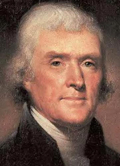
 |
Thomas Jefferson
b. 2/13 Apr 1743, "Shadwell", Goochland (now Albemarle) County, Virginia [1]
d. 4 Jul 1826, Monticello (near Charlottesville), Albemarle County, Virginia |
| Title: |
President of the United States |
| Term: |
4 Mar 1801 - 4 Mar 1805 |
| Chronology: |
17 Feb 1801, elected, session of the House of Representatives, House Chamber, U.S. Capitol, Washington, D.C. [2][3] |
|
4 Mar 1801,
commencement of term |
|
4 Mar 1801,
took the oath of office as the President of the United States, special session of the Senate, Senate Chamber, U.S. Capitol, Washington, D.C. [4] |
|
4 Mar 1805,
expiration of term |
| Term: |
4 Mar 1805 - 4 Mar 1809 |
| Chronology: |
13 Feb 1805,
the election to the office of the President of the United States is declared upon the ascertainment and counting of the electoral vote (cast 5 Dec 1804), joint session of the Senate and House of Representatives, Senate Chamber, U.S. Capitol, Washington, D.C. [5] |
|
4 Mar 1805,
commencement of term |
|
4 Mar 1805,
took the oath of office as the President of the United States, inaugural ceremony, Senate Chamber, U.S. Capitol, Washington, D.C. [6] |
|
4 Mar 1809,
expiration of term |
| Biography: |
| Attended a preparatory school; attended William and Mary College, Williamsburg, Virginia, (1760-1762), graduating in 1762; studied law with George Wythe at Williamsburg; admitted to the bar and commenced practice in 1767; elected a member of the House of Burgesses of the Colony of Virginia (1769-1776) for Albemarle County; attended Virginia Conventions at Richmond (1775); elected a delegate from Virginia to the Continental Congress (1775-1776); chairman of the committee that drew up, primary author of, and signer of the Declaration of Independence 1776; was appointed Commissioner to France, but declined to serve (1776); served as Governor of the Commonwealth of Virginia (1? Jun 1779 - 2 Jun 1781); member, State house of delegates 1782; was re-elected a delegate from Virginia to the Continental Congress (1783-1784); in absence of the President of Congress, served as Chairman of Congress on two occasions (12 Mar 1784 - 13 Mar 1784, 30 Mar 1784); appointed a Minister Plenipotentiary to France (resolution of Congress of 7 May 1784), and then sole Minister to the King of France (resolution of Congress of 10 Mar 1785); nominated to the office of Secretary of State (letter of President of the United States of 25 Sep 1789) and was confirmed by the Senate (26 Sep 1789); returned to the United States in 1789; served as Secretary of State (22 Mar 1790 - 31 Dec 1793) in the Cabinet of President George Washington; resigned the office (effective 31 Dec 1793) and retired to his estate, Monticello, Virginia; elected Vice President of the United States (4 Mar 1797 - 4 Mar 1801) and served under President John Adams; elected President of the United States in 1801 by the House of Representatives on the 36th ballot; acquisition of the Louisiana Territory in 1803; reelected in 1804; second administration was notable for his unsuccessful efforts to convict former vice president, Aaron Burr, of treasonable acts in the southwestern territories, and for efforts to pursue a policy of neutrality during the Napoleonic Wars; Embargo Act (1807) was based on the power given to the Congress to regulate commerce with foreign nations; retired to Monticello; active in founding the University of Virginia at Charlottesville. |
| Biographical sources: Biographical Directory of the United States Congress (2005). |
| Elections: |
| Candidate |
Electoral vote (3 Dec 1800) |
| Thomas Jefferson |
73 |
| Aaron Burr |
73 |
| John Adams |
65 |
| Charles Cotesworth Pinckney |
64 |
| John Jay |
1 |
| total number of electors appointed |
138 |
| number of votes for a majority |
70 |
|
House vote (date) |
| 1st-19th (11 Feb 1801) |
20th-28th (12 Feb 1801) |
29th (13 Feb 1801) |
30th-33rd (14 Feb 1801) |
34th (16 Feb 1801) |
35th (17 Feb 1801) |
36th (17 Feb 1801) |
| Jefferson |
8 |
8 |
8 |
8 |
8 |
8 |
10 |
| Burr |
6 |
6 |
6 |
6 |
6 |
6 |
4 |
| divided |
2 |
2 |
2 |
2 |
2 |
2 |
— |
| blank |
— |
— |
— |
— |
— |
— |
2 |
| required |
9 |
| Candidate |
Electoral vote (5 Dec 1804) |
| Thomas Jefferson |
162 |
| Charles Cotesworth Pinckney |
14 |
| total number of electors appointed |
176 |
| number of votes for a majority |
89 |
|
| Source of electoral results: House Journal, 6th Congress, 2nd Session, 799, 801-803; Senate Journal, 8th Congress, 2nd Session, 453. |
| |
| [1] |
The date of birth of Thomas Jefferson is recorded in his own hand in the Jefferson Family Book of Common Prayer preserved in the University of Virginia Library, A 1752 .C87 no.1. |
| [2] |
The electoral votes cast 3 Dec 1800 were counted at the joint session of the Senate and House of Representatives held in the Senate Chamber 11 Feb 1801. The counting revealed that two candidates had the greatest number of votes (73 each) and received a majority of the votes of all the electors appointed. The election then devolved to the House of Representatives, where each state was entitled to cast a single vote. The voting took place from 11 Feb 1801 to 17 Feb 1801. The results were the same for all votes through the 35th with two states divided in their choice. On the 36th ballot, Jefferson received a majority, with 10 states choosing him, 4 favouring Burr, and 2 abstaining. |
| [3] |
House Journal, 6th Congress, 2nd Session, 799-803. |
| [4] |
Senate Journal, 6th Congress, 2nd Session, Appendix, 147-150. |
| [5] |
Senate Journal, 8th Congress, 2nd Session, 452-453. |
| [6] |
Annals of Congress, 9th Congress, 4th Session, 77-80; Senate Executive Journal, Volume 1, 486-490. |
|
Image: portrait by Rembrandt Peale, 1800. |
