 |
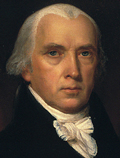
James Madison, Jr.
b. 5/16 Mar 1751, Port Conway, King George County, Virginia
d. 28 Jun 1836, Montpelier mansion, Orange County, Virginia |
| Title: |
President of the United States |
| Term: |
4 Mar 1809 - 4 Mar 1813 |
| Chronology: |
8 Feb 1809,
election to the office of President of the United States is declared upon counting electoral votes (cast 7 Dec 1808),
joint session of the Senate and House of Representatives, House Chamber, U.S. Capitol, Washington, D.C. [1] |
|
4 Mar 1809,
commencement of term |
|
4 Mar 1809,
took an oath of office as President of the United States, special session of the Senate, House Chamber, U.S. Capitol, Washington, D.C. [2] |
|
4 Mar 1813,
expiration of term |
| Term: |
4 Mar 1813 - 4 Mar 1817 |
| Chronology: |
10 Feb 1813,
election to the office of President of the United States is declared upon counting electoral votes (cast
2 Dec 1812),
joint session of the Senate and House of Representatives, House Chamber, U.S. Capitol, Washington, D.C. [3] |
|
4 Mar 1813,
commencement of term |
|
4 Mar 1813,
took an oath of office as President of the United States, inaugural ceremony, House Chamber, U.S. Capitol, Washington, D.C. [4] |
|
4 Mar 1817,
expiration of term |
| Biography: |
| A member of the Virginia planter class, James Madison graduated from the College of New Jersey (now Princeton University) in 1771. He became member of the committee of safety from Orange County (1774) and was elected delegate in the Williamsburg Convention (1776). As a member of the First General Assembly of Virginia (1776), Madison was unanimously elected a member of the Executive Council in 1778. Madison served as a member of the Continental Congress (1780-1783, 1787-1788), and delegate in the Federal Constitutional Convention (1787). He played important role in drafting the Constitution and was elected to the US Congress (1789-1797). He declined the mission to France (1794) and also the position of Secretary of State (1794). During the administration of Thomas Jefferson, Madison was appointed Secretary of State (5 Mar 1801 - 4 Mar 1809) entering upon the duties of that office 2 May 1801. In 1808 Madison was elected president of the United States to succeed Jefferson. The controversy over the trade with Great Britain and France resulted in reimposing the trade embargo with Great Britain (1811), which had been repealed after Jefferson left office. This act and the demands of "war party" of Henry Clay and John C. Calhoun helped bring on the war with Great Britain declared on 18 Jun 1812 (War of 1812). Despite the initial defeats of the US armies, Madison was reelected president in late 1812. In 1813, the US Army and Navy won several victories (battles of Lake Erie, Thames River), but in August 1814 the British took Washington and burned the Capitol and the White House forcing the president to flee. After a series of battles both sides agreed to negotiations. On 24 Dec 1814 the Treaty of Ghent was signed providing for the cessation of hostilities. The last years of Madison's presidency witnessed the rise of a new nationalism. In 1816, the Congress passed protective tariff regulations and a new charter for the Bank of the United States. The expansion of national borders included the admission to the Union the States of Louisiana (30 Apr 1812), and Indiana (11 Dec 1816). After the expiration of his second term as president, Madison retired to his estate, "Montpelier," Orange County, Virginia. In 1829 he was a delegate in the Virginia constitutional convention. He also served as rector of the University of Virginia at Charlottesville. |
| Biographical sources: Biographical Directory of the United States Congress (2005). |
| Elections: |
| Candidate |
Electoral vote (7 Dec 1808) |
| James Madison |
122 |
| Charles Cotesworth Pinckney |
47 |
| George Clinton |
6 |
| total number of electors appointed |
176 |
| number of votes for a majority * |
89 |
| Candidate |
Electoral vote (2 Dec 1812) |
| James Madison |
128 |
| DeWitt Clinton |
89 |
| total number of electors appointed |
218 |
| number of votes for a majority † |
110 |
|
| * One elector did not vote (requirements for attaining a majority for election) |
| † One elector did not vote (requirements for attaining a majority for election) |
| Source of electoral results: House Journal, 10th Congress, 2nd Session, 514;
House Journal, 12th Congress, 2nd Session, 670.
|
| |
| [1] |
House Journal, 10th Congress, 2nd Session, 513-515. |
| [2] |
Annals of Congress, Senate, 10th Congress, 2nd Session, 462-465. |
| [3] |
House Journal, 12th Congress, 2nd Session, 669-671. |
| [4] |
Annals of Congress, Senate, 12th Congress, 2nd Session, 121-124. |
|
Image: portrait by John Vanderlyn, 1816. |
