 |
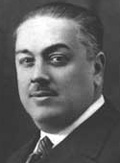
Diego Martínez Barrio
b. 25 Nov 1883, Seville, Spain
d. 1 Jan 1962, Paris, France |
| Title: |
Presidente de la República (President of the Republic) [1] |
| Term: |
8 Apr 1936 - 11 May 1936 |
| Chronology: |
8 Apr 1936, took an oath of office, session of the Congreso de los Diputados, Palacio del Congreso, Madrid [2][3] |
|
11 May 1936, ceased to exercise the duties of office upon the inauguration of a successor [4] |
| Other offices: |
Presidente del Consejo de Ministros (President of the Council of Ministers) [8 Oct 1933 - 16 Dec 1933, 19 Jul 1936 - 19 Jul 1936] see details |
| Biography: |
| Received secondary education; worked in a printing-house, then as a journalist; joined the Unión Republicana (Republican Union) in 1903; contributed to forming the Partido Radical (Radical Party) in Seville (1907); served in Seville municipal council (1910-1913, 1920-1923); as a republican leader, he was persecuted during the dictatorship of Primo de Rivera; served as minister of communications (15 Apr 1931 - 16 Dec 1931) in the first two republican governments; was elected a deputy for Seville to the Constituent Cortes (Cortes Constituyentes, 1931-1933); minister of the interior (12 Sep 1933 - 8 Oct 1933) in the cabinet of Alejandro Lerroux y García; was appointed President of the Council of Ministers (8 Oct 1933 - 16 Dec 1933); resigned after his government accomplished the task of holding first general election to the Cortes; elected to the Cortes where he represented Seville (1933-1935) and Madrid (1936-1939); minister of war (16 Dec 1933 - 23 Jan 1934), Vice-President of the Council of Ministers (22 Dec 1933 - 3 Mar 1934), and minister of the interior (23 Jan 1934 - 3 Mar 1934) in the second cabinet of Lerroux; distanced from Lerroux and formed the Partido Radical Demócrata (Democratic Radical Party), which eventually merged into the newly established Unión Republicana (Republican Union) in 1934; was elected President of the Cortes (interim 16 Mar 1936 - 3 Apr 1936, permanent 3 Apr 1936 - 30 Mar 1939); upon the removal from office of President of the Republic Niceto Alcalá-Zamora, assumed the presidency (8 Apr 1936 - 11 May 1936) as a constitutional successor until the next election; was appointed President of the Council of Ministers (19 Jul 1936 - 19 Jul 1936), but resigned the same day being unable to form a stable government; shortly before the end of the Civil War, he presided at the last session of the Cortes on Spanish soil at Figueras (1 Feb 1939 - 2 Feb 1939); fled to France (5 Feb 1939); presided the meetings of the Diputación Permanente de las Cortes (Standing Committee of the Cortes) in Paris until 30 Mar 1939; moved to Mexico; was elected Presidente Interino de la República (Interim President of the Republic) by votes of 96 deputies of the Cortes gathered at Mexico City (17 Aug 1945); acted as top official of the Spanish government-in-exile until his death.
|
| Biographical sources: "Memorias", by Diego Martínez Barrio (Barcelona: Planeta, 1983). |
| |
| [1] |
Usually, though informally, styled Presidente interino de la República. |
| [2] |
Diario de las sesiones de Cortes, No. 15, 7 Apr 1936, p. 271; Gaceta de Madrid. Diario Oficial de la República, No. 99, 8 Apr 1936, p. 227. |
| [3] |
As the holder of the office of Presidente de las Cortes, Martínez Barrio became eligible to assume the office of Presidente de la República as a designated successor in accordance with Art. 74 of the Constitution of 1931 and the resolution passed by the Congreso de los Diputados at about 22:50 7 Apr 1936, discharging the incumbent for violation of constituitonal provisions. The resolution was communicated to Alcalá-Zamora at his private residence by the Board of the Cortes between 22:50 and 23:55 7 Apr 1936. After the Board accomplished its task and drafted an act dated 23:55 7 Apr 1936, the session of the Congreso suspended at 22:50 7 Apr 1936 was resumed at 00:25 8 Apr 1936. As soon as a secretary read out the act of discahrge and corresponding article of the Constitution (Art. 74), Vice President of the Cortes proclaimed: "Una delegación de la Mesa irá en busca del señor Presidente de las Cortes, que pasa a ser Presidente de la República." Martínez Barrio was invited to take an oath of office and did so before the session was closed at 00:35 8 Apr 1936. His presidential term was counted from the moment of his swearing-in as provided by Art. 72 of the Constitution ("El Presidente de la República prometerá ante las Cortes, solemnemente reunidas, fidelidad a la República y a la Constitución. Prestada esta promesa, se considerará iniciado el nuevo periodo presidencial.") |
| [4] |
Diario de las sesiones de Cortes, No. 28, 12 May 1936, pp. 683-684 (verbatim record of the session of 12 May 1936 includes an act of swearing-in ceremony held on 11 May 1936). |
