 |
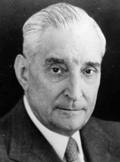
António de Oliveira Salazar
b. 28 Apr 1889, Vimieiro, near Santa Comba Dão, Beira Alta
d. 27 Jul 1970, Lisbon |
| Title: |
Presidente do Ministério (President of the Ministry) |
| Term: |
5 Jul 1932 - 11 Apr 1933 |
| Chronology: |
5 Jul 1932, appointed, decree of President of the Republic [1] |
| |
11 Apr 1933, discharged, decree of President of the Republic [2] |
| Title: |
Presidente do Conselho de Ministros (President of the Council of Ministers) [3] |
| Term: |
11 Apr 1933 - 18 Jan 1936 |
| Chronology: |
11 Apr 1933, appointed, decree of President of the Republic [2] |
| |
15 Apr 1935, entered upon the duties of Presidente da República pending the installation of an incumbent [4] |
| |
26 Apr 1935, ceased to exercise the duties of Presidente da República upon the installation of an incumbent [5] |
| |
18 Jan 1936, discharged, decree of President of the Republic [6] |
| Term: |
18 Jan 1936 - 27 Sep 1968 |
| Chronology: |
18 Jan 1936, appointed, decree of President of the Republic [6] |
| |
18 Apr 1951, entered upon the duties of Presidente da República pending the election and installation of an incumbent [7] |
| |
9 Aug 1951, ceased to exercise the duties of Presidente da República upon the installation of an incumbent [8] |
| |
27 Sep 1968, discharged, decree of President of the Republic [9] |
| Biography: |
| Born in the family of estate manager; received education at the seminary of Viseu (1900-1908), but decided to abandon ecclesiastical career; attended Colégio da Via Sacra at Viseu (1908-1910); entered (1910) the University of Coimbra, graduating with a bachelor's degree in law (1914); gained a doctorate in finance and economics (1918); became professor of political economy at the University of Coimbra; elected a deputy of the Câmara dos Deputados (Chamber of Deputies) on the ticket of the Portuguese Catholic Center (Centro Católico Português), representing Guimarães (1921); resigned as deputy (1921) to return to academic career; briefly served as finance minister (3 Jun 1926 - 19 Jun 1926) in the Cabinet Mendes Cabeçadas; returned to the office of finance minister (28 Apr 1928 - 28 Aug 1940) during the presidency of Óscar Carmona; assumed full control of Portuguese economy and succeeded in achieving stability of economic development; drafted a new constitution (1933) that reorganized Portugal's political system along authoritarian lines; chief architect of the corporative and authoritarian state (Estado Novo); served as interim minister of colonies (21 Jan 1930 - 29 Jul 1930, 3 Nov 1930 - 6 Nov 1930), interim minister of war (5 Jul 1932 - 6 Jul 1932, 11 May 1936 - 6 Sep 1944), interim minister of foreign affairs (24 Nov 1936 - 4 Feb 1947); supported the Spanish Nationalists during the Civil War (1936-1939); maintained relations with Portugal's traditional ally, United Kingdom, and permitted the Allies to use the Azores as a base during World War II; assumed the position of minister of national defense (13 Apr 1961 - 4 Dec 1962), following unsuccessful attempt of military coup led by Botelho Moniz (11 Apr 1961). |
| Biographical sources: "Os Presidentes da República Portuguesa", coord. by António Costa Pinto and Maria Inácia Rezola (Lisboa: Temas & Debates, 2001) |
| |
| [1] |
Diário do Govêrno, I Série, No. 155, 5 Jul 1932, Supplement, pp. 1389-1390. |
| [2] |
Diário do Govêrno, I Série, No. 83, 11 Apr 1933, Supplement, p. 657. |
| [3] |
The Constitution of 1933 contains the following official terms: Presidente de Conselho and Conselho de Ministros. The style Presidente do Conselho de Ministros was also in official use. |
| [4] |
Diário de Lisboa, No. 4457, 16 Apr 1935; provisionally assumed the functions of Presidente da República in view of inability of Óscar Carmona to take an oath of office due to health problems. |
| [5] |
Diário das Sessões, n.° 47, 27 de Abril de 1935, p. 999; Diário de Lisboa, Sexta-feira, 26 de Abril de 1935, N.° 4467. |
| [6] |
Diário do Govêrno, I Série, No. 15, 18 Jan 1936, Supplement, p. 79. |
| [7] |
Provisionally assumed the functions of Presidente da República following the death of Óscar Carmona. |
| [8] |
Diário das Sessões, n.° 108, 10 de Agosto de 1951, p. 1023. |
| [9] |
Diário do Governo, I Série, No. 229, 27 Sep 1968, p. 1509. |
| |
Image: photograph, 1968. |
