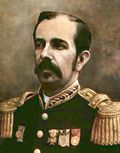
 |
Floriano Vieira de Araújo Peixoto
b. 30 Apr 1839, Riacho Grande, Vila de Ipioca, Alagoas
d. 29 Jun 1895, Divisa, near Barra Mansa, Rio de Janeiro |
| Title: |
Vice-Presidente da República da República dos Estados Unidos do Brasil (Vice President of the Republic of United States of Brazil) |
| Term: |
26 Feb 1891 - 15 Nov 1894 |
| Chronology: |
25 Feb 1891, elected to the office of Vice President of the Republic of the United States of Brazil,
session of the Congresso Nacional Constituinte (National Constituent Congress), Palacio da Quinta da Boa Vista, Rio de Janeiro [1] |
| |
26 Feb 1891,
made an affirmation required by law at the ceremony of installation as Vice President of the Republic of the United States of Brazil, session of the Congresso Nacional Constituinte (National Constituent Congress), Palacio da Quinta da Boa Vista, Rio de Janeiro [2] |
| |
23 Nov 1891, assumed the functions of
Presidente da República dos Estados Unidos do Brasil (President of the Republic of the United States of Brazil) upon resignation of an incumbent [3] |
| |
15 Nov 1894, expiration of term [4] |
| Biography: |
| Son of a small landowner; graduated from military school in 1863; actively participated in the Paraguayan War (1864-1870) and was promoted to lieutenant-colonel (1870) and brigadier (1882); assumed the post of military commander and President of the Province of Mato Grosso (1884-1885); was dismissed as a result of a conflict with the central government; after staying at his estate in Alagoas for four years (1885-1889), he returned to the army and was made field marshal (1889); refused to execute an order of the imperial Council of Ministers to disperse a public rally in Rio de Janeiro 15 Nov 1889, when the military overthrew Emperor Pedro II; was appointed war minister (1890-1891) in the Provisional Government chaired by Marshal Deodoro da Fonseca; elected federal senator for the State of Alagoas (1890); elected Vice President of the Republic by the National Constituent Congress (25 Feb 1891); political and personal animosity between him and Marshal Deodoro hampered the work of government; assumed the presidency (23 Nov 1891) after Marshal Deodoro resigned in the course of of political turmoil caused by his decision to dissolve a dissenting National Congress; recalled the Congress dissolved by his predecessor and won the approval of legislators to continue acting as head of state until the end of the constitutionally mandated term. In a series of dismissals known as "19 coups" (1891-1892), he removed almost all state governors appointed by Fonseca. In April 1892 Peixoto suppressed the political movement initiated by military leaders demanding direct election of president of the Republic. In December 1893 his government was involved in another conflict with a part of the Brazilian Navy, which joined the federalist revolution in Santa Catarina. Supported by the landowners of São Paulo, Peixoto severely crushed the opposition and presided over transition to the civilian government in 1894. |
| Biographical sources: História da República Brasileira (1979). |
| Elections: |
| Candidate |
Vote (25 Feb 1891) |
| Floriano Vieira de Araújo Peixoto |
153 |
| Eduardo Wandenkolk |
57 |
| Prudente José de Morais e Barros |
12 |
| Antônio Carlos da Silva Piragibe |
5 |
| José de Almeida Barreto |
4 |
| Custódio José de Melo |
1 |
|
| Source of electoral results: Annaes do Congresso Constituinte (1890), 3:917. |
| |
| [1] |
Annaes do Congresso Constituinte (1890), 3:917. |
| [2] |
Annaes do Congresso Constituinte (1890), 3:921. |
| [3] |
Art. 42 of the 1891 Constitution provided that in any case of vacancy of the office of President or of Vice President occurring when two years of the presidential term of office have not yet elapsed, a new election is to be held. Peixoto, who took office upon the resignation of Fonseca before a year of the term of office had elapsed, held that Art. 1 of the Transitional Provisions provided in its Paragraph 1 that the President and Vice-President elected by the Congress were to hold office during the whole designated first presidential term, and that therefore he was bound by this provision, which superseded Art. 42, this article to come into operation only with the first constitutionally elected President and Vice-President; and that consequently the provision that in case of vacancy of the office of President the Vice President would succeed to the office was not applicable to him, wherefore he continued to style himself Vice-Presidente da República. |
| [4] |
: "Art 43 <...> § 4º - O primeiro período presidencial terminará a 15 de novembro de 1894." |
