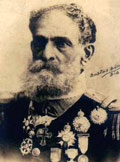
 |
Manuel Deodoro da Fonseca
b. 5 Aug 1827, Alagoas (now Marechal Deodoro), Alagoas
d. 23 Aug 1892, Rio de Janeiro |
| Title: |
Chefe do Governo Provisório da República dos Estados Unidos do Brasil (Head of the Provisional Government of the Republic of the United States of Brazil) [1] |
| Term: |
15 Nov 1889 - 26 Feb 1891 |
| Chronology: |
15 Nov 1889, assumed the office upon proclamation of the Provisional Government [2] |
| |
26 Feb 1891, ceased to exercise the duties of office |
| Title: |
Presidente da República dos Estados Unidos do Brasil (President of the Republic of the United States of Brazil) |
| Term: |
26 Feb 1891 - 23 Nov 1891 |
| Chronology: |
25 Feb 1891, elected to the office of President of the Republic of the United States of Brazil,
session of the Congresso Nacional Constituinte (National Constituent Congress), Palacio da Quinta da Boa Vista, Rio de Janeiro [3] |
| |
26 Feb 1891,
made an affirmation required by law at the ceremony of installation as President of the Republic of the United States of Brazil, session of the Congresso Nacional Constituinte (National Constituent Congress), Palacio da Quinta da Boa Vista, Rio de Janeiro [4] |
| |
23 Nov 1891, ceased to exercise the duties of office upon signing a letter of resignation [5] |
| Biography: |
| Manuel Deodoro da Fonseca graduated from a military school in Rio de Janeiro (1847). His military career began with the suppression of the Praiera Revolution in Pernambuco (1848-1849). Upon his return to Rio de Janeiro, he was promoted to captain. In 1856 Fonseca was again sent to Pernambuco and then to Mato Grosso. He fought in the Paraguayan War (1864-1870) attaining the rank of colonel. Promoted to brigadier (1874) and field marshal (1884), Fonseca served as a military commander of Rio Grande do Sul, where he also temporarily held the presidency of this province (1886). A founding member and president of the Military Club (1887), Marshal Deodoro was a leader of the Brazilian military, who staged a coup against Emperor Pedro II and proclaimed the Republic of the United States of Brazil (15 Nov 1889). Fonseca assumed the leadership of the Provisional Government, presiding over the election of the Constituent Congress (15 Sep 1890). Convened on 15 Nov 1890, the Congress promulgated a new constitution (24 Feb 1891) and elected Fonseca first president of the Republic (25 Feb 1891). The Fonseca government divided by political and personal animosity between the president and vice president Floriano Peixoto encountered a strong opposition within the Congress, which chose a policy of obstruction. Arbitrary presidential decrees including concession of the port of Torres to a private company had serious repercussion on the Congress and public opinion. The situation approached a climax when Fonseca dissolved the National Congress and declared the state of emergency (3 Nov 1891). A group of deputies opposed this decision and found support among the high-ranked officers of the Navy including Admiral Custódio José de Melo. The marshal found himself on the brink of a civil war threatening to engulf the nation. On 23 Nov 1891 he signed a resignation and turned over the presidency to Floriano Peixoto. |
| Biographical sources: "História da República", by José Maria Bello (São Paulo: Companhia Editora Nacional, 1972, 6th edition); "Marshal Deodoro and the fall of Dom Pedro II", by Charles Willis Simmons (Durham: Duke University Press, 1966). |
| Elections: |
| Candidate |
Vote (25 Feb 1891) |
| Manuel Deodoro da Fonseca |
129 |
| Prudente José de Morais e Barros |
97 |
| Floriano Vieira de Araújo Peixoto |
3 |
| Joaquim Saldanha Marinho |
2 |
| José Higino Duarte Pereira |
1 |
| blank |
2 |
|
| Source of electoral results: Annaes do Congresso Constituinte (1890), 3:916. |
| |
| [1] |
The formula frequently but not exclusively used for promulgation of laws: "Chefe do Governo Provisório da República dos Estados Unidos do Brasil, constituído pelo Exército e Armada, em nome da Nação..." (see Decretos do Governo Provisório) |
| [2] |
"Diário Official da Republica Federativa Brazileira", ano XXVIII, N. 315, 16 de novembre de 1889. |
| [3] |
Annaes do Congresso Constituinte (1890), 3:916. |
| [4] |
Annaes do Congresso Constituinte (1890), 3:921. |
| [5] |
Arquivo Nacional do Rio de Janeiro. Cofre. Cód. 981 in Textos Políticos da História do Brasil, 3:306 |
