 |
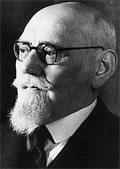
Karl Renner
b. 14 Dec 1870, Unter-Tannowitz, Moravia (now Dolní Dunajovice, Czech Republic) [1]
d. 31 Dec 1950, Vienna, Austria |
| Title: |
Bundespräsident (Federal President) |
| Term: |
20 Dec 1945 - 31 Dec 1950 |
| Chronology: |
20 Dec 1945, elected, session of the Bundesversammlung (Federal Assembly), Großer Sitzungssaal des Parlaments, Parlamentsgebäude, Vienna [2] |
| |
20 Dec 1945, took an oath of office, session of the Bundesversammlung (Federal Assembly), Großer Sitzungssaal des Parlaments, Parlamentsgebäude, Vienna [2] |
| |
31 Dec 1950, died [3] |
| Names/titles: |
Pen-names: Synopticus; Rudolf Springer |
| Biography: |
| Eighteenth child of a poor Moravian farmer; attended village school; studied law at the University of Vienna (1890-1896), receiving degree in 1898; was a founder of the Naturfreunde association (1895); employed as librarian at the library of the Reichsrat, Vienna (from 1895); joined the Social Democratic Workers' Party (Sozialdemokratische Arbeiterpartei, SDAP); wrote a number of works in political studies; elected a member of the Reichsrat (1907-1918); member of the Provisorische Nationalversammlung (Provisional National Assembly) (1918-1919); headed the Austrian government as Leiter der Kanzlei des Staatsrates (Chief of the Chancellery of the Staatsrat) (30 Oct 1918 - 19 Dec 1918]; office converted to Staatskanzler (State Chancellor) (19 Dec 1918 - 7 Jul 1920); member of the Konstituierende Nationalversammlung (Constituent National Assembly) (1919-1920); reelected as State Chancellor (15 Mar 1919, 17 Oct 1919) by the Constituent National Assembly; served as chief of the State Department of the Interior and Education (1919), chief of the State Department of Foreign Affairs (1919), state secretary for foreign affairs (1919-1920); advocated the idea of Anschluss, calling for unification of Austria with Germany; chaired the Austrian delegation at negotiations in Saint-Germain-en-Laye (1919), resulting in signing the peace treaty (10 Sep 1919) between Austria and the victorious Allied Powers in World War I; elected a member of the Nationalrat (National Council) (1920-1934); was a founder of the Arbeiterbank (1923), chairman of the Board of the Arbeiterbank (1923-1926); unsuccessful candidate at presidential elections (5 Dec 1928, 9 Oct 1931); served as President of the National Council (29 Apr 1931 - 4 Mar 1933); was briefly imprisoned after the abortive 1934 coup; supported the annexation of Austria by the Nazi Germany (1938); remained politically inactive during World War II; joined (1945) the Socialist Party (Sozialistische Partei Österreichs, SPÖ); approved as State Chancellor (27 Apr 1945 - 20 Dec 1945) and formed a provisional government composed of the Socialists, People's Party, and Communists; elected Bundespräsident, first Head of State of the Second Republic of Austria (served 20 Dec 1945 - 31 Dec 1950); died in office (31 Dec 1950). |
| Biographical sources: "Der erste Präsident: Karl Renner - eine politische Biografie", by Richard Saage (Vienna: Paul Zsolnay Verlag, 2016). |
| Elections: |
| Candidate |
Vote (20 Dec 1945) |
| Karl Renner |
204 |
| blank/invalid |
1 |
| total number of votes cast |
205 |
|
| Source of electoral results: Wiener Zeitung, No. 79, 21 Dec 1945, p. 1. |
| |
| [1] |
Karl Renner and his twin brother Anton were born and baptised on 14 Dec 1870 as is evident from their birth and baptism record preserved in the Archives of Brno, Czech Republic, book of births and baptisms of the Roman Catholic church in Unter-Tannowitz, 1862-1888, f. 174; original spelling of his first name in the record: Carl. |
| [2] |
Wiener Zeitung, No. 79, 21 Dec 1945, p. 1. |
| [3] |
Wiener Zeitung, No. 1, 3 Jan 1951, p. 1. |
| |
Image: contemporary photograph, Bildarchiv der Österreichischen Nationalbibliothek, Vienna. |
