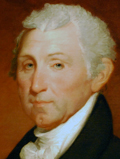
 |
James Monroe
b. 28 Apr 1758, Westmoreland County, Virginia
d. 4 Jul 1831, New York City, New York |
| Title: |
President of the United States |
| Term: |
4 Mar 1817 - 4 Mar 1821 |
| Chronology: |
12 Feb 1817,
election to the office of President of the United States is declared upon counting electoral votes (cast 4 Dec 1816), joint session of the Senate and House of Representatives, House Chamber, Brick Capitol, Washington, D.C. [1] |
|
4 Mar 1817,
commencement of term |
|
4 Mar 1817,
took an oath of office as President of the United States, inaugural ceremony as part of the special session of the Senate, in front of the Brick Capitol, Washington, D.C. [2] |
|
4 Mar 1821,
expiration of term |
| Term: |
4 Mar 1821 - 4 Mar 1825 |
| Chronology: |
14 Feb 1821,
election to the office of President of the United States is declared upon counting electoral votes (cast 6 Dec 1820),
joint session of the Senate and House of Representatives, House Chamber, U.S. Capitol, Washington, D.C. [3] |
|
4 Mar 1821,
commencement of term [3] |
|
5 Mar 1821,
took an oath of office as President of the United States, inaugural ceremony, House Chamber, U.S. Capitol, Washington, D.C. [4][5] |
|
4 Mar 1825,
expiration of term |
| Biography: |
| Attended Campbelltown Academy (1769-1774); studied at William and Mary College (1774-1776); joined a party of revolutionaries which seized weapons from Governor's Palace in Williamsburg (24 Jun 1775); enlisted as cadet in the Third Virginia Infantry Regiment of the Continental Army (1776); commissioned a lieutenant in the spring of 1776; participated in numerous engagements in the Revolutionary War; was promoted to captain (1777), major (1777); resigned from the army (20 Dec 1778, effective 12 Jan 1779); lieutenant-colonel in Virginia State Line (1779); returned to William and Mary College (1780), began to study law with Thomas Jefferson; elected (4 Apr 1782) a member of the House of Delegates of the Commonwealth of Virginia from King George County (sworn in 6 May 1782); admitted to the bar (1782); vacated his seat when he was appointed (7 Jun 1782) to the Council of State (1782-1783); elected (6 Jun 1783) a member of the Continental Congress (1783-1786); resigned as a member of the Council of State (last attended 21 Oct 1783); re-elected to the Continental Congress in 1784 and 1785; elected to Virginia House of Delegates from Spotsylvania County (1787-1789); was a member of Convention of 1788 to ratify the Federal Constitution; elected to the U.S. Senate (9 Nov 1790 - 27 May 1794), but resigned his seat as he was appointed Minister Plenipotentiary to France (1794-1796); served as Governor of the Commonwealth of Virginia (19 Dec 1799 - 1 Dec 1802), and returned to diplomatic service as Minister Plenipotentiary to France (1803), and Minister Plenipotentiary to Great Britain (1803-1807); returned home in 1808; returned to Virginia House of Delegates (1810-1811) from Albemarle County; after briefly serving the second term as Governor of Virginia (19 Jan 1811 - 3 Apr 1811), he was appointed Secretary of State (6 Apr 1811 - 4 Mar 1817, acting secretary 1 Oct 1814 - 28 Feb 1815) and later Secretary of War (27 Sep 1814 - 2 Mar 1815) in the Cabinet of James Madison; elected President of the United States in 1816; his entrance upon the duties of president marked the beginning of "era of good feeling" (1817-1825); in 1817 the US entered into the Seminole War; a dispute with Spain over the boundary in Florida was resolved by the Adams-Onís Treaty (1819), by which Spain ceded Florida to the United States; financial crisis of 1819 was followed by the first conflict over slavery settled by the Missouri Compromise in 1820; reelected for the second term (1820); during his presidency the States of Mississippi (10 Dec 1817), Illinois (3 Dec 1818), Alabama (14 Dec 1819), Maine (15 Mar 1820), and Missouri (10 Aug 1821) were admitted to the Union; in his presidential message of 2 Dec 1823, he expressed the principles of a new foreign policy, which later became known as the Monroe Doctrine; most important legislative acts of the Monroe's second administration included the laws on protective tariff and internal improvements (1824; upon leaving the office of president, he retired to his farm in Loudoun County, Virginia; was a member and president of the Virginia constitutional convention of 1829. |
| Biographical sources: Biographical Directory of the United States Congress (2005); "A Comprehensive Catalogue of the Correspondence and Papers of James Monroe", ed. by Daniel Preston (Westport, CT: Greenwood Publishing Group, 2001), 2 vols. |
| Elections: |
| Candidate |
Electoral vote (4 Dec 1816) |
| James Monroe |
183 |
| Rufus King |
34 |
| total number of electors appointed |
221 |
| number of votes for a majority * |
111 |
| Candidate |
Electoral vote (6 Dec 1820) † |
| |
including votes from Missouri |
excluding votes from Missouri |
| James Monroe |
231 |
228 |
| John Quincy Adams |
1 |
1 |
| total number of electors appointed |
235 |
232 |
| number of votes for a majority ‡ |
118 |
117 |
|
| * Four electors did not vote (requirements for attaining a majority for election) |
| † Due to a disagreement over counting electoral votes from Missouri, the results were declared "were the votes of Missouri to be counted" and "if not counted" (Concurrent Resolution of the U.S. Congress of 14 Feb 1821, House Journal, 16th Congress, 2nd Session, 233-235).
|
| ‡ Three electors did not vote (requirements for attaining a majority for election)
|
| Source of electoral results: House Journal, 14th Congress, 2nd Session, 388-389;
House Journal, 16th Congress, 2nd Session, 234; Senate Journal, 16th Congress, 2nd Session, 191.
|
| |
| [1] |
House Journal, 14th Congress, 2nd Session, 385-389; Annals of Congress, 14th Congress, 2nd Session, 943-950. |
| [2] |
Annals of Congress, 14th Congress, 2nd Session, 218-226. |
| [3] |
House Journal, 16th Congress, 2nd Session, 232-236; Senate Journal, 16th Congress, 2nd Session, 189-192. |
| [4] |
Inauguration was postponed as 4 Mar 1821 fell on a Sunday. |
| [5] |
Annals of Congress, 16th Congress, 2nd Session, 1303-1312. |
|
Image: portrait by Gilbert Stuart, c. 1820-1822. |
