 |
Andrew Jackson
b. 15 Mar 1767, Waxhaw Settlement, South Carolina (?) [1]
d. 8 Jun 1845, "Hermitage", near Nashville, Tennessee |
| Title: |
President of the United States |
| Term: |
4 Mar 1829 - 4 Mar 1833 |
| Chronology: |
11 Feb 1829,
election to the office of President of the United States is declared upon counting electoral votes (cast 3 Dec 1828),
joint session of the Senate and House of Representatives, House Chamber, U.S. Capitol, Washington, D.C. [2] |
|
4 Mar 1829,
commencement of term |
|
4 Mar 1829,
took an oath of office as President of the United States, inaugural ceremony as part of the special session of the Senate, East Portico, U.S. Capitol, Washington, D.C. [3] |
|
4 Mar 1833,
expiration of term |
| Term: |
4 Mar 1833 - 4 Mar 1837 |
| Chronology: |
13 Feb 1833,
election to the office of President of the United States is declared upon counting electoral votes (cast 5 Dec 1832),
joint session of the Senate and House of Representatives, House Chamber, U.S. Capitol, Washington, D.C. [4] |
|
4 Mar 1833,
commencement of term |
|
4 Mar 1833,
took an oath of office as President of the United States, inaugural ceremony, House Chamber, U.S. Capitol, Washington, D.C. [5] |
|
4 Mar 1837,
expiration of term |
| Biography: |
| Posthumous son of an immigrant from Northern Ireland; received a sporadic education in local schools; in the age of thirteen, he participated in action against the British army (1781); was captured and imprisoned at Camden, South Carolina; lost all members of his immediate family in the course of the War of Independence; worked for a time in a saddler's shop and afterward apparently taught school in the Waxhaw settlement; studied law in Salisbury, North Carolina; admitted to the bar in 1787; moved to Jonesboro (now Tennessee) in 1788 and commenced practice; appointed solicitor of the western district of North Carolina, comprising what is now the State of Tennessee, in 1788; held the same position in the territorial government of Tennessee after 1791; delegate to the convention to frame a constitution for the new State 1796; upon the admission of Tennessee as a State into the Union was elected to the 4th and 5th Congresses and served from 5 Dec 1796, until his resignation in September 1797; elected as a Republican in September 1797 to the Senate for the term that had commenced 4 Mar 1797, and served from 26 Sep 1797, until his resignation in April 1798; judge of the State supreme court of Tennessee (1798-1804); engaged in planting and in mercantile pursuits; served in the Creek War of 1813 as commander of Tennessee forces; his victory in the Creek War brought him a commission as major general in the US Army in May 1814; led his army to victory over the British in the Battle of New Orleans in January 1815; received the thanks of Congress and a gold medal by resolution of 27 Feb 1815; commanded an expedition which captured Florida in 1817; was appointed Commissioner of the United States to take possession of East and West Florida ceded by Spain by the Adams–Onís Treaty of 1819 (commission dated 10 Mar 1821); served as Governor of the Provinces of the Floridas (10 Mar 1821 - 31 Dec 1821); resigned this office (letter of resignation dated 13 Nov 1821, accepted 31 Dec 1821) and was again elected to the Senate (4 Mar 1823 - 14 Oct 1825); chairman, Committee on Military Affairs (18th Congress); unsuccessful candidate for President in 1824; elected as a Democrat as President of the United States in 1828; conflicted with the second Bank of the United States; vetoed the legislation renewing the bank's charter sent to Congress on 10 Jul 1832; brandished presidential prerogative against South Carolina during the nullification crisis when this state adopted a resolution declaring high protective tariffs of 1828 and 1832 null and void; reelected in 1832; issued the Specie Circular in July 1836, requiring payment in gold or silver for all public lands; retired to his country home, the "Hermitage," near Nashville, Tennessee, where he died. |
| Biographical sources: Biographical Directory of the United States Congress (2005); "A Compilation of the Messages and Papers of the Presidents, 1789-1902", ed. by James D. Richardson (Washington, D.C.: Bureau of National Literature and Art, 1903), vol. II-III. |
| Elections: |
| Candidate |
Electoral vote (3 Dec 1828) |
| Andrew Jackson |
178 |
| John Quincy Adams |
83 |
| total number of electors appointed |
261 |
| number of votes for a majority |
131 |
| Candidate |
Electoral vote (5 Dec 1832) |
| Andrew Jackson |
219 |
| Henry Clay |
49 |
| John Floyd |
11 |
| William Wirt |
7 |
| total number of electors appointed |
288 |
| number of votes for a majority * |
145 |
|
| * Two electors did not vote (requirements for attaining a majority for election) |
| Source of electoral results: Register of Debates, 20th Congress, 2nd Session, 350; Register of Debates, 22nd Congress, 2nd Session, 1723. |
| |
| [1] |
The documentary evidence on the date and time of Jackson's birth does not exist. James Parton in his "Life of Andrew Jackson" (Boston: Ticknor and Fields, 1866) used the recollections of Jackson's distant relatives and urban legends recorded by Samuel H.Walkup, asserting that he was born in the house of the uncle, George McKemey in Mecklenburg (later Union) County, North Carolina. Other authorities agree that Jackson was born in the house of an uncle, but disagree over the identity of the uncle as James Crawford, another Jackson's uncle, lived in Waxhaw Settlement, South Carolina. See "Andrew Jackson - The Border Captain", by Marquis James (Indianapolis: Bobbs-Merrill Co., 1933), pp. 368-374. |
| [2] |
Register of Debates, 20th Congress, 2nd Session, 350. |
| [3] |
Senate Journal, 20th Congress, 2nd Session, 196-199. |
| [4] |
Register of Debates, 22nd Congress, 2nd Session, 1722-1723. |
| [5] |
Daily National Intelligencer, Vol. XXI, No. 6262, Washington: Tuesday, March 5, 1833. |
|
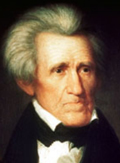
Image: Portrait of Andrew Jackson by Asher B. Durand. |
