 |
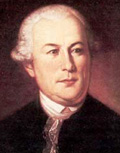
Elias Boudinot
b. 21 Apr/2 May 1740, Philadelphia, Pennsylvania
d. 24 Oct 1821, Burlington, Burlington County, New Jersey |
| Title: |
President of Congress |
| Term: |
4 Nov 1782 - 2 Nov 1783 |
| Chronology: |
4 Nov 1782,
elected to the office of the President of Congress, session of Congress, State House, Philadelphia, Pennsylvania [1] |
|
2 Nov 1783,
term of delegate (and subsequently as the President of Congress) is deemed to have expired upon convening of a new Congress [2] |
| Biography: |
| Descendant of French Huguenots; received a classical education; studied law and was admitted to the bar in 1760; was a member of the board of trustees of Princeton College (1772-1821); during the Revolutionary War, he was a member of the committee of safety of New Jersey (1775); elected a delegate from New Jersey to the Continental Congress (1778, 1781-1783); was elected the President of Congress (4 Nov 1782 - 2 Nov 1783); his presidency was highlighted by the work on signing a peace treaty with Great Britain; a preliminary agreement was concluded in Paris on 30 Nov 1782, but it took almost a year to finalize the Treaty of Paris, which was signed on 3 Sep 1783; during this period, the Congress declared an end to the Revolutionary War (11 Apr 1783), and disbanded the Continental Army; facing protests from angry and unpaid war veterans, Congress left Philadelphia and relocated to Princeton, New Jersey (24 Jun 1783); after his term as a Congress delegate expired, he resumed the practice of law; was elected to the U.S. Congress (served 4 Mar 1789 - 3 Mar 1795); held the office of director of the Mint (Oct 1795 - Jul 1805); was elected first president of the American Bible Society (1816).
|
| Biographical sources: Biographical Directory of the United States Congress (2005), p. 683; "E. B.: The Story of Elias Boudinot IV, His Family, His Friends, and His Country", by Barbara Louise Clark (Ardmore, PA: Dorrance, 1977); "The Life, Public Services, Addresses, and Letters of Elias Boudinot: President of the Continental Congress", by Elias Boudinot, Jane J. Boudinot (Boston and New York: Houghton, Mifflin, and Co., 1896). |
| Elections: |
| Candidate |
Vote of States |
| Elias Boudinot |
7 |
| Theodorick Bland |
2 |
| Abner Nash |
1 |
| John Rutledge |
1 |
|
| Source of electoral results: "The Papers of James Madison", ed. by Henry D. Gilpin (Mobile: Allston Mygatt, 1842), 1:187. |
| |
| [1] |
Journals of the Continental Congress, 23:708. |
| [2] |
Journals of the Continental Congress, 25:795ff. |
