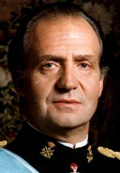
 |
Juan Carlos I
b. 5 Jan 1938, Rome, Italy
|
| Title: |
Rey de España (King of Spain) |
| Term: |
22 Nov 1975 - 19 Jun 2014 |
| Chronology: |
23 Jul 1969, designated as a constitutional successor to the office of Jefe del Estado (Head of State) with the title of Príncipe de España (Prince of Spain) to be conferred upon swearing-in, Law 62/1969 is passed by the Cortes 22 Jul 1969 and becomes effective upon the publication in official gazette 23 Jul 1969 as provided by Art. 5 of the same law [1] |
|
23 Jul 1969, took an oath as the Prince of Spain, session of the Cortes Españolas (Spanish Cortes), salón de sesiones, Palacio de las Cortes Españolas, Madrid [2] |
|
22 Nov 1975, took an oath as the King of Spain, joint session of the Cortes Españolas (Spanish Cortes) and Consejo del Reino (Council of the Kingdom), salón de sesiones, Palacio de las Cortes Españolas, Madrid [3][4] |
| |
19 Jun 2014, abdication becomes effective in accordance with an organic law passed by the Cortes Generales (Congreso de los Diputados on 11 Jun 2014, Senado 17 Jun 2014), promulgated by the king 18 Jun 2014 and taking effect upon publication 19 Jun 2014 as prescribed by Art. 2 of the same law [5] |
| Names/titles: |
Baptised: Juan Carlos Alfonso Víctor María de Borbón y de Borbón-Dos Sicilias; Príncipe de España (Prince of Spain) [23 Jul 1969 - 22 Nov 1975] |
| Biography: |
| Second child of Infante Juan de Borbón y Battenberg conde de Barcelona, son of King Alfonso XIII; was born during the exile of the royal family living in Italy after the Revolution of 1931; received primary education at Fribourg, Switzerland, and San Sebastián, Spain; graduated with bachelor's decree from the San Isidro School in Madrid (1954); attended the Joint Military Academy of Zaragoza (1955-1957), Navy Academy of Pontevedra (1957-1958) and Joint Academy of Air Force of San Javier (1958-1959); studied law, economy and public administration at the Complutense University of Madrid (1960-1961); was designated as successor to Francisco Franco Bahamonde (23 Jul 1969); was made brigade general of the infantry, rear admiral, and brigade general of the air force (23 Jul 1969); confirmed at position of "heredero de la Corona" ("heir to the Crown") and temporary head of state for the cases of Franco's incapacity or absence (Law No. 26/1971); provisionally exercised the functions of Head of State during the illness of Franco (19 Jul 1974 - 2 Sep 1974, 30 Oct 1975 - 20 Nov 1975); promoted to captain general of the army, navy and air force (20 Nov 1975); in accordance with the Law on Succession in the Headship of State (Ley de Sucesión en la Jefatura del Estado, 1947), installed as King of Spain (22 Nov 1975); received dynastic rights and position as Head of the Spanish Royal Household from his father (14 May 1977); became constitutional ruler after the coming into effect of the Constitution of Spain (29 Dec 1978). |
| Biographical sources: "Juan Carlos: A People's King", by Paul Preston (London: HarperCollins, 2004). |
| |
| [1] |
Boletín Oficial de las Cortes Españolas. Núm. 1.061. Sesión plenaria y extraordinaria celebrada los días 22 y 23 de julio de 1969. P. 25887 - 25900; Boletín Oficial del Estado. Gaceta de Madrid. Miércoles 23 de julio de 1969. Núm. 175. PP. 11607-11608. |
| [2] |
Boletín Oficial de las Cortes Españolas. Núm. 1.061. Sesión plenaria y extraordinaria celebrada los días 22 y 23 de julio de 1969. P. 25900 - 25905. |
| [3] |
Boletín Oficial de las Cortes Españolas. Diario de las sesiones del pleno. X Legislatura. Núm. 21. Sesión Extraordinaria y Conjunta de las Cortes Españolas con el Consejo del Reino, para recibir juramento y proclamar Rey a S.A.R. Don Juan Carlos de Borbón y Borbón, celebrada el día 22 de noviembre de 1975. PP. 1-7. |
| [4] |
The Organic Law of the State (1967), incorporating and adjusting all previous "leyes fundamentales del reino", and specifically the Law on Succession in the Headship of State (1947), provided for the office of Jefe del Estado, held at the time of promulgation by Francisco Franco Bahamonde, to pass, upon the demise of the office, to a person "a título de Rey o Regente". The language of this legislation specified, on its face, that the successor, while styled Rey or Regente, as the case might be, would hold the office of, and exercise the functions assigned to, the Jefe del Estado, as there styled. The language might have been deliberately ambiguous regarding this style; in the event, Don Juan Carlos I, upon succeeding to the office, was in all contexts styled Rey de España. |
| [5] |
Boletín Oficial del Estado, No. 148, 19 Jun 2014, pp. 46396-46398. |
