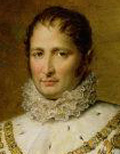
 |
José I Napoleón
b. 7 Jan 1768, Corte, Corsica [1]
d. 28 Jul 1844, Florence, Grand Duchy of Tuscany |
| Title: |
Por la gracia de Dios, Rey de las Españas y de las Indias (By the Grace of God, King of the Spains and of the Indies) |
| Term: |
6 Jun 1808 - 7 Jul 1808 |
| Chronology: |
6 Jun 1808, appointed, decree of Napoléon Ier who uses his hereditary rights to the thrones of the Spains and the Indies ceded to him by King Carlos IV [2] |
| Title: |
Por la gracia de Dios y la Constitución del Estado, Rey de las Españas y de las Indias (By the Grace of God and Constitution of the State, King of the Spains and of the Indies) [3] |
| Term: |
7 Jul 1808 - 13 Dec 1813 |
| Chronology: |
7 Jul 1808, royal style changed upon enacting the Constitution of 1808 and swearing-in, 12th (and the last) meeting of the Diputación General de españoles, "Palacio llamado el Obispado viejo", Bayonne, France [4] |
|
23 Jul 1808, proclaimed in Madrid [5] |
|
28 Jun 1813,
ceased to exercise the functions of office upon leaving national territory [6][7] |
| Names/titles: |
Baptised (8 Jan 1768): Joseph Nabulion; styled (by courtesy): roi Joseph [from Jan 1814] |
| Other offices: |
Re di Napoli e di Sicilia (King of Naples and Sicily) as Giuseppe Napoleone [11 May 1806 - 8 Jul 1808] |
| Biography: |
| Descended from the Corsican family of noble origin; elder brother of Napoléon Bonaparte (= Napoléon Ier); was educated at the Collège d'Autun, Burgundy (1779-1784); attended the University of Pisa (1787-1788) where he studied law; admitted to the bar at Bastia, Corsica (1788); was elected a deputy for Ajaccio to sit in the Consulta (1791) convened at Orezza; was made a member of the administration of the département of Corse (1792-1793); fled to France after coming into conflict with Corsican nationalist leader, Pasquale Paoli (1793); joined the revolutionary army and participated in the siege of Toulon (1793); accompanied Napoléon in Italian campaign of 1796; participated in a military expedition sent to occupy Corsica (1796); was appointed envoy to the Duchy of Parma (27 Mar 1797); elected to the Conseil des Cinq-Cents (Council of Five Hundred) (1797-1799) as a representative of the département of Liamone, Corsica; appointed minister plenipotentiary (6 May 1797) and ambassador of the French Republic (15 May 1797) to the Holy See; presented his credentials to Pius VI (28 Sep 1797); with eruption of Jacobin riot, was compelled to flee from Rome (29 Dec 1797); admitted to the Council of Five Hundred and took oath as deputy (23 Jan 1798); served as a secretary of the Council of Five Hundred (20 Jun 1798 - 19 Jul 1798); supported the coup of 18 Brumaire, Year VIII (9 Nov 1799 - 10 Nov 1799); was made a member (conseiller d'État) of the Conseil d'État (Council of State, 1800-1802); was a signatory of the Treaty of Lunéville (9 Feb 1801) with the Holy Roman Empire and of the Treaty of Amiens (25 Mar 1802) with the United Kingdom; negotiated the Concordat with the Holy See (copies exchanged 10 Sep 1801); was made a member of the Sénat conservateur (1802-1814); promoted to colonel (1804); created Premier prince du sang (18 May 1804) and Grand-électeur (Grand Elector, 18 May 1804); was offered the Crown of Lombardy, but rejected (response communicated to Napoléon 27 Jan 1805); promoted to division general (1806); sent by Napoléon Ier to conquer the Kingdoms of Naples and Sicily with instructions to assume the title of "gouverneur général des royaumes de Naples et de Sicile" (letter of Napoléon I, 9 Feb 1806); entered Naples 15 Feb 1806; was created the King of Naples and Sicily by an imperial decree of Napoléon Ier (30 Mar 1806, presented to Joseph in Naples on 11 May 1806); ordered to come to Bayonne, France (Napoléon's letter of 11 May 1808, received 21 May 1808); left Naples 23 May 1808; appointed King of the Spains and of the Indies by decree of Napoléon Ier (6 Jun 1808); arrived to Bayonne (7 Jun 1808); signed the Constitution of Bayonne (6 Jul 1808) and was sworn in as constitutional monarch (7 Jul 1808); ceded his rights to the Crowns of Naples and Sicily in favour of Napoléon Ier by a treaty (5 Jul 1808, effective on 8 Jul 1808); entered the territory of Spain (9 Jul 1808), reaching Madrid by 20 Jul 1808; evacuated Madrid (29 Jul 1808) after defeat of the French army at Bailén; restored to his power with invasion of the grand army under Napoléon Ier, which seized Madrid on 3-4 Dec 1808; returned to Madrid (22 Jan 1809), continuing warfare with the Spanish national resistance and their English allies; was displeased with limitation of his power by French military commanders; grew increasingly frustrated with his mission and failed to pursue independent course in politics despite his appeals to Napoléon; participated in a number of campaigns and battles [8]; following the defeat in the Battle of Vitoria (21 Jun 1813), he abandoned Spain, crossing the border on 28 Jun 1813 near Bera, Navarre; served as lieutenant-général de l'Empereur (lieutenant-general of the emperor, appointed 28 Jan 1814) and commander-in-chief of the National Guard (1814); departed for Switzerland (1814), but returned to France on 19 Mar 1815; peer of France (22 Apr 1815); moved to the United States where he lived under the pseudonym of the Comte de Survilliers at Bordentown, New Jersey; returned to Europe in 1832. |
| Biographical sources: Lentz, Thierry. Joseph Bonaparte. Paris: Perrin, 2016. |
| |
| [1] |
Bosc, Célestin. Les éphémérides ajacciennes : 1790-1896. Bastia: Fabiani, 1897, p. 21; Lentz, Thierry. Joseph Bonaparte. Paris: Perrin, 2016, pp. 13-23. |
| [2] |
Gazeta de Madrid, del martes, 14 de Junio de 1808, Núm. 57, pp. 568-569. |
| [3] |
On coins: DEI GRATIA HISPANIARUM ET IND(IARUM) REX (By the Grace of God, King of the Spains and the Indies). |
| [4] |
Gazeta de Madrid, del miercoles, 20 de Julio de 1808, Núm. 92, pp. 849-569. |
| [5] |
Gazeta de Madrid, del domingo, 24 de Julio de 1808, Núm. 96, p. 884. |
| [6] |
"Mémoires du comte Miot de Melito" (Paris: Michel Lévy Frères, 1858), vol. 3, p. 284. |
| [7] |
After leaving Spain (28 Jun 1813), Joseph Bonaparte did not have an opportunity to meet with Napoléon until 28 Nov 1813 when the brothers met at Saint-Cloud. Napoléon urged Joseph to abdicate the throne of Spain. While Joseph was hesitating, Napoléon and Fernando VII empowered their representatives to sign a treaty of peace at Valençay, France (11 Dec 1813), providing in Art. 3 for restoration and international recognition of Fernando VII as King of the Spains and of the Indies. Joseph indicated his intention to abdicate in a letter to Napoléon of 29 Dec 1813 if certain conditions are met. Although he never signed a formal abdication, but he finally acquiesced in the transfer of the Spanish crown to the House of Borbón in a letter to Napoléon of 7 Jan 1814. See "Mémoires du comte Miot de Melito", op. cit., pp. 308-329. |
| [8] |
Absent from Madrid: 29 Jul 1808 - 22 Jan 1809, 22 Jun 1809 - 13 Jul 1809, 21 Jul 1809 - 15 Aug 1809, 8 Sep 1809 - 12 Sep 1809, 18 Nov 1809 - ? Dec 1809, 8 Jan 1810 - 14 May 1810, 18 Sep 1810 - 21 Sep 1810, 23 Apr 1811 - 15 Jul 1811 (10 May 1811 - 27 Jun 1811 in France), 20 Jul 1812 - 2 Aug 1812, 10 Aug 1812 - 2 Nov 1812, 4 Nov 1812 - 2 Dec 1812, 17 Mar 1813 - 28 Jun 1813 (left Spain). |
|
Image: portrait by François baron Gérard (after 1808). |
