 |
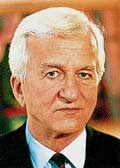
Richard Karl Freiherr von Weizsäcker
b. 15 Apr 1920, Stuttgart, German Reich
d. 31 Jan 2015, Berlin, Federal Republic of Germany
|
| Title: |
Bundespräsident (Federal President) |
| Term: |
1 Jul 1984 - 30 Jun 1989 |
| Chronology: |
23 May 1984,
elected, session of the Bundesversammlung (Federal Assembly), Beethovenhalle, Bonn [1] |
| |
1 Jul 1984,
took an oath of office as Federal President, joint session of the Bundestag and Bundesrat, Bonn [2] |
| Term: |
1 Jul 1989 - 30 Jun 1994 |
| Chronology: |
23 May 1989,
elected, session of the Bundesversammlung (Federal Assembly), Beethovenhalle, Bonn [3] |
| |
30 Jun 1994, expiration of term |
| Other offices: |
Regierender Bürgermeister [Governing Mayor (of Berlin)] (11 Jun 1981 - 9 Feb 1984) (see details) |
| Biography: |
| Born in the family of diplomat Ernst Freiherr von Weizsäcker; studied philosophy and history in Oxford and Grenoble; joined the army (1938) and participated in World War II fighting in the battles against Poland and Soviet Union; continued his studies in Göttingen (1945-1950) and as lawyer defended his father prosecuted as Nazi state official; made a career in the 1950s mostly connected with the Mannesmann AG mining company; was also an active participant in the Evangelist church affairs serving on many ecclesiastic councils; joined the Christian Democratic Union (CDU) in 1954; remained politically inactive until 1965, when Helmut Kohl proposed his candidacy for the parliamentary elections, but he refused to participate; became a member of the CDU federal board (1966) and was finally elected to the Bundestag in 1969; was considered as a possible candidate to the federal presidency (1968), but the choice fell on Gerhard Schröder, who eventually lost to Gustav Heinemann; while the CDU was in opposition (1969-1982), he actively worked on the party's new program and was a candidate to the post of CDU/CSU leader in the Bundestag, but Karl Carstens assumed the office in May 1973; lost 32 votes to Walter Scheel at the presidential elections (1974); served as Vice President of the Bundestag (21 Jun 1979 - 21 Mar 1981); resigned the office to become the Governing Mayor of West Berlin (11 Jun 1981 - 9 Feb 1984); was elected Federal President (23 May 1984) easily defeating the independent candidate Luise Rinser, supported by the Greens and the Free Democrats; running unopposed for the first time in the history of presidential elections in Germany, he was reelected in 1989; his second term witnessed the process of the unification of Germany; in 1994 the seat of the German presidency was transferred to the Schloß Bellevue in Berlin. |
| Biographical sources: "Die Bundespräsidenten: Biographien eines Amtes", by Günther Scholz (Heidelberg: Decker & Müller, 1990). |
| Elections: |
| Candidate (party) |
Vote (23 May 1984) |
| Richard von Weizsäcker (CDU/CSU) |
832 |
| Luise Rinser (independent, Green Party nomination) |
68 |
| abstentions |
117 |
| invalid |
11 |
| total votes cast |
1,028 |
| total votes/absolute majority: |
1,040/521 |
| Candidate (party) |
Vote (23 May 1989) |
| Richard von Weizsäcker (CDU) |
881 |
| with "no" |
108 |
| abstentions |
30 |
| invalid |
3 |
| total votes cast |
1,022 |
| total votes/absolute majority: |
1,038/520 |
|
| Source of electoral results: Verhandlungen des Deutschen Bundestages, 10. Wahlperiode, Bd. 128, Sonderdruck; Verhandlungen des Deutschen Bundestages, 11. Wahlperiode, Bd. 149, Sonderdruck. |
| |
| [1] |
Verhandlungen des Deutschen Bundestages, 10. Wahlperiode, Bd. 128, Sonderdruck. |
| [2] |
Verhandlungen des Deutschen Bundestages, 10. Wahlperiode, Bd. 128, S. 5791-5808. |
| [3] |
Verhandlungen des Deutschen Bundestages, 11. Wahlperiode, Bd. 149, Sonderdruck. |
