 |
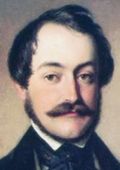
Carl Friedrich Wilhelm Emich
b. 12 Sep 1804, Amorbach, Principality of Leiningen
d. 13 Nov 1856, Schloß Waldleiningen, near Amorbach, Kingdom of Bavaria |
| Title: |
Präsident des Reichsministerrates (President of the Reich Council of Ministers) |
| Term: |
5 Aug 1848 - 5 Sep 1848 |
| Chronology: |
5 Aug 1848,
appointed by the Reichsverweser (Reich Vicar) [1][2] |
| |
5 Sep 1848,
resignation of the Council of Ministers accepted by the Reich Vicar; the incumbent continues in office under a new style until the appointment of successor [3] |
| Title: |
Interimistischer Präsident des Reichsministerrates (Interim President of the Reich Council of Ministers)
|
| Term: |
5 Sep 1848 - 16 Sep 1848 |
| Chronology: |
16 Sep 1848, discharged by the Reich Vicar acting on request for resignation submitted 5 Sep 1848 |
| Names/titles: |
Fürst zu Leiningen (Prince of Leiningen) [from 4 Jul 1814]; given name also spelled: Karl |
| Biography: |
| The son of Emich Carl Fürst zu Leiningen and Marie Luise Victoire Prinzessin von Sachsen-Coburg-Saalfeld (English: Mary Louise Victoria Princess of Saxe-Coburg-Saalfeld); through his mother, who married Prince Edward Prince of Kent (29 May 1818), he was half-brother of Alexandrina Victoria, future Queen Victoria of the United Kingdom of Great Britain and Ireland; educated by private tutors; attended a private school in Bern, Switzerland; studied law at the University of Göttingen (1821-1823); spent long periods of time in England with his mother; succeeded to the estates of Leiningen after the death of his father (4 Jul 1814); member of the Kammer der Reichsräte (Chamber of Reich Counselors) of the Kingdom of Bavaria (from 1819); member of the Erste Kammer (First Chamber) of Grand Duchy of Hesse (from 1820); member of the Erste Kammer (First Chamber) of Grand Duchy of Baden (from 1833); one of the founders of the Adelsverein (1842), an association for directing German immigration to America; president of the Bavarian Chamber of Reich Counselors (1842-1843, 1845-1846, 1847); was known as liberal and progressive thinker, advocating introduction of the parliamentary system of government and the abolition of aristocratic privilege; backed by the Zentralisationspartei (Party of Centralization), was appointed President of the Reich Council of Ministers (5 Aug 1848) by Imperial Vicar Johann; put forward political program of the Reichsdiktatur; offered his resignation (5 Sep 1848) after the voting on the issue of armistice in the war with Denmark, unilaterally concluded by Prussia; continued to lead the government as Interim President (5 Sep 1848 - 16 Sep 1848) until his resignation was finally accepted. |
| Biographical sources: "Neue deutsche Biographie", Hrsg. von der Historischen Kommission bei der Bayerischen Akademie der Wissenschaften; Schriftleiter: Otto zu Stolberg-Wernigerode (Berlin: Duncker & Humblot, 1953-) Bd. 14. S. 145-146. ; "Genealogische Geschichte des uradeligen, reichsgräflichen und reichsfürstlichen, standesherrlichen, erlauchten Hauses Leiningen und Leiningen-Westerburg", by Dr. Ed. Brinckmeier (Braunschweig: Verlag von Richard Sattler, 1890). Bd. 1; "Das Fürstentum Leiningen vor und nach der Mediatisierung", by Gerhard Wild (Mainz: 1954). |
| |
| [1] |
Frankfurter Oberpostamts-Zeitung, Beilage zu Nro. 223, Donnerstag, 10. August 1848, p. 1. |
| [2] |
Appointment of ministers and undersecretaries by the Reich Vicar were made by the instruments of appointment dated 5 Aug 1848 and 9 Aug 1848 (Frankfurter Oberpostamts-Zeitung, Beilage zu Nro. 223, Donnerstag, 10. August 1848, p. 1). A report on the appointment of the whole council was dated 9 Aug 1848 and submitted to the Constituent National Assembly 10 Aug 1848 (Verhandlungen der deutschen constituierenden Nationalversammlung, 2:1465-1466). |
| [3] |
A report of Leiningen dated 6 Sep 1848, concerning the resignation of the Council of Ministers, is submitted the Constituent National Assembly 8 Sep 1848 (Verhandlungen der deutschen constituierenden Nationalversammlung, 3:1919). |
