 |
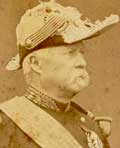
Marie-Edmé-Patrice-Maurice de Mac Mahon
b. 13 Jun 1808, Château de Sully, Saône-et-Loire [1]
d. 17 Oct 1893, Château de La Forest, Loiret |
| Title: |
Président de la République française (President of the French Republic) |
| Term: |
24 May 1873 - 30 Jan 1879 |
| Chronology: |
24 May 1873,
elected, session of the Assemblée nationale (National Assembly), opéra du Palais de Versailles, Versailles [2] |
|
24 May 1873,
assumed the functions of office, meeting with a delegation of the National Assembly, hôtel du commandant militaire (earlier known as hôtel d'Alaigre and hôtel des Fermes), rue de Gravelle (now rue de Fontenay), Versailles [3] |
|
20 Nov 1873, executive authority conferred on Mac Mahon with the title of Président de la République for the term of seven years, starting with the promulgation of the law passed by the National Assembly [4] |
|
30 Jan 1879, letters of resignation (both dated 30 Jan 1879, Versailles) communicated to the Chamber of Deputies and to the Senate, acknowledged [5] |
| Names/titles: |
Styled: comte de Mac Mahon (count of Mac Mahon); duc de Magenta (duke of Magenta) [from 5 Jun 1859]; correct form of family name: Mac Mahon (without hyphen) [6] |
| Biography: |
| A noble of Irish origin; educated at the Military Academy of Saint-Cyr (École spéciale militaire de Saint-Cyr) (1825-1827) and the École d'État-major (1827-1829); commissioned second lieutenant (1829); distinguished himself during the expedition to Algeria (1830); promoted to lieutenant (1830), captain (1833), commandant (1840), lieutenant colonel (1843/1844), colonel (1845), brigade general (1848), general of division (1852); participated in the Crimean War (1853-1856) and in the Italian campaign (1859); nominated senator (1856-1870); after his victory over the Austrians at Magenta, was created duc de Magenta and marshal of France (5 Jun 1859); served as governor-general of Algeria (1 Sep 1864 - 27 Jul 1870); was defeated and captured at Sedan during the Franco-Prussian war (1870-1871); returned to head the Versailles Army, which defeated the Paris Commune (May 1871); elected President of the Republic (24 May 1873) after the resignation of Adolphe Thiers; when the French monarchists failed to install Comte de Chambord as a new king under the name of Henri V, the presidential tenure was extended to seven years (Law of the Septennate, 20 Nov 1873); republican form of government was formally established with promulgation of constitutional laws (25 Feb 1875); parliamentary elections of 1876 brought victory to republicans, who secured the appointment of the moderate republican Jules Simon as President of the Council of Ministers (12 Dec 1876 - 17 May 1877); forced Simon to resign (17 May 1877) that created constitutional crisis (crise du Seize Mai); succeeded in dissolving (25 Jun 1877) the Chambre des députés (Chamber of deputies); was prevented from effective decision-making by the republicans, who received majority in the Sénat in early 1879; protested against the draft law on high military command proposed by the ministry of Armand Dufaure and tendered his resignation on 30 Jan 1879. |
| Biographical sources: "Histoire complète de Mac-Mahon, maréchal de France, duc de Magenta : d'après des documents originaux et des pièces officielles", by Léon Laforge (Paris: Lamulle et Poisson, 1898) (web site); "Mac Mahon", by Gabriel de Broglie (Paris: Perrin, 2000). |
| Elections: |
| Candidate |
Vote (24 May 1873) |
| votes cast |
392 |
| blank |
1 |
| valid votes |
391 |
| absolute majority |
196 |
| Marie-Edmé-Patrice-Maurice de Mac Mahon |
390 |
| François-Jules-Paul Grévy |
1 |
|
| Source of electoral results: Annales de l'Assemblée nationale, 18:68. |
| |
| [1] |
Original birth record is preserved in the Archives of the Saône-et-Loire département, 5 E 530/2, p. 63/68: "Du quatorze juin, au mil huit cent huit, heure de sept du matin. Acte de naissance de Monsieur de Mac Mahon, du sexe masculin, né à Sully le jour d'hier, heure de midy, fils de M. Maurice François de Mac Mahon, profession de propriétaire, demeurant audit Sully et de Madame Marie Edme Pelagie Biquet de Caraman, auquel enfant a été donné le prénom de Marie Edmé Patrice Maurice." The record was also printed in "Histoire complète de Mac-Mahon", op. cit., 3:198. |
| [2] |
Annales de l'Assemblée nationale, 18:68. |
| [3] |
The meeting is described in details in an article from "L'Union" re-printed in "Journal des débats politiques et littéraires", édition de Paris, 27 May 1873, pp. 1-2; location is defined in "Mémoirs" by duc de Broglie, Part VI, in Revue des deux mondes: recueil de la politique, de l'administration et des moeurs, 1 Sep 1929, p. 155. |
| [4] |
Bulletin des lois de la République française, № 163: № 2463 - Loi qui confie le Pouvoir exécutif pour sept ans au Maréchal de Mac Mahon, Duc de Magenta, in "Bulletin des lois de la République française", XIIe série, deuxième semestre de 1873. Partie principale. T. 7 (Paris: Imprimerie nationale, 1874), p. 717. |
| [5] |
JORF, No. 30, 31 Jan 1879, pp. 675-677. |
| [6] |
Although Mac-Mahon is the spelling frequently used by himself, the correct form is Mac Mahon without hyphen (see "Mac Mahon", op. cit., 17). |
|
Image: photograph by Eugène Appert. |
