 |
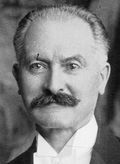
Albert-François Lebrun
b. 29 Aug 1871, Mercy-le-Haut, Meurthe-et-Moselle
d. 6 Mar 1950, Paris |
| Title: |
Président de la République française (President of the French Republic) |
| Term: |
10 May 1932 - 10 May 1939 |
| Chronology: |
10 May 1932,
elected, session of the Assemblée nationale (National Assembly), salle des séances de la Chambre des députés, Palais de Versailles, Versailles [1] |
|
10 May 1932,
assumed the functions of office, public ceremony, Palais de Versailles, Versailles [2] |
|
10 May 1939, expiration of term |
| Term: |
10 May 1939 - 11 Jul 1940 |
| Chronology: |
5 Apr 1939,
elected, session of the Assemblée nationale (National Assembly), salle des séances de la Chambre des députés, Palais de Versailles, Versailles [3] |
|
10 May 1939,
commencement of term [5] |
|
11 Jul 1940, office of Président de la République française is abolished in accordance with a constitutional law promulgated 11 Jul 1940 |
| Biography: |
| Born in the family of a mayor of Mercy-le-Haut, Meurthe-et-Moselle; was educated at a lyceum in Nancy; received degrees from the Ecole polytechnique (1890) and Ecole des mines (1896); served in the army (1892-1893); worked as mining engineer (1896-1901); general counselor for Audun-le-Roman (from 1898); president of the General Council of Meurthe-et-Moselle (1906-1932); elected to the Chambre des députés [Chamber of Deputies] (1900-1920); minister for colonies (27 Jun 1911 - 12 Jan 1913, 9 Dec 1913 - 9 Jun 1914); vice president of the Chamber of Deputies (1913); minister of war (12 Jan 1913 - 21 Jan 1913); served as artillery officer during World War I (1914-1915); minister for blockade (23 Nov 1917 - 24 Dec 1918); minister for the liberated regions (23 Nov 1917 - 6 Nov 1919); elected senator from Meurthe-et-Moselle (1920-1932); vice president (1925-1931) and president of the Sénat (11 Jun 1931 - 10 May 1932); moderate conservative, was elected President of the Republic (10 May 1932); rarely exerted political influence on cabinet appointments or policy; reelected (5 Apr 1939); complied with the cabinet's decisions (June 1940) that led to the armistice with Germany; acquiesced in the constitutional revisions at Vichy through which Marshal Philippe Pétain took over as head of state; retired to Vizille near Grenoble; interned by the Germans at Itter in Tirol (1943-1944); acknowledged General Charles de Gaulle as head of the provisional government. |
| Biographical sources: birth record in in the Archives of the Meurthe-et-Moselle département, 5 Mi 362/R 6, record No. 21 (1871); "Le dernier président de la IIIème République", by Éric Freysselinard (Paris: Belin, 2013). |
| Elections: |
| Candidate |
Vote (10 May 1932) |
| votes cast |
826 |
| blank/invalid |
49 |
| valid votes |
777 |
| absolute majority |
389 |
| Albert-François Lebrun |
633 |
| Paul Favre |
114 |
| Paul Painlevé |
12 |
| Gilles-Marcel Cachin |
8 |
| scattered |
10 |
| Candidate |
Vote (5 Apr 1939) |
| votes cast |
910 |
| blank/invalid |
6 |
| valid votes |
904 |
| absolute majority |
453 |
| Albert-François Lebrun |
506 |
| Albert Bedouce |
151 |
| Gilles-Marcel Cachin |
74 |
| Édouard-Marie Herriot |
53 |
| François-Pierre-Marie-Justin Godart |
50 |
| Fernand-Émile-Honoré Bouisson |
16 |
| François-Sampiero-Sébastien-Marie-Jourdan Piétri |
10 |
| scattered |
44 |
|
| Source of electoral results: JORF - Débats parlementaires, No. 52, 11 May 1932, Assemblée nationale, pp. 1-4; JORF - Débats parlementaires, No. 38, 6 Apr 1939, Assemblée nationale, pp. 1-4. |
| |
| [1] |
JORF - Débats parlementaires, No. 52, 11 May 1932, Assemblée nationale, pp. 1-4. |
| [2] |
JORF - Lois et décrets, No. 110, 11 May 1932, pp. 4954-4955. |
| [3] |
JORF - Débats parlementaires, No. 38, 6 Apr 1939, Assemblée nationale, pp. 1-4. |
| [4] |
The second term of Lebrun was not marked by any public ceremony. An updated Grand Collar of the Legion of Honour (Grand Collier de la Légion d'Honneur) was privately presented to him 10 May 1939 (Le Temps, No. 28364, 11 May 1939, p. 8) |
