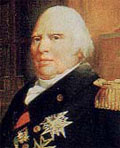
 |
Louis XVIII
b. 17 Nov 1755, Versailles
d. 16 Sep 1824, Paris |
| Title: |
Par la grâce de Dieu, Roi de France et de Navarre (By the Grace of God, King of France and Navarre) |
| Term: |
2 May 1814 - 20 Mar 1815 |
| Chronology: |
24 Jun 1795, received the news on demise of Louis-Charles de France recognized as King Louis XVII by royalists and the Powers, Verona, Republic of Venice; subsequently issued a proclamtion on succession [1] |
|
2 May 1814, authority of King Louis XVIII acknowledged, royal declaration announced (Déclaration de Saint-Ouen), meeting of the king with parliamentary and administrative bodies, château de Saint-Ouen [2][3][4] |
|
20 Mar 1815, ceased to exercise royal functions upon abandoning Paris [5] |
| Term: |
8 Jul 1815 - 16 Sep 1824 |
| Chronology: |
8 Jul 1815, resumed royal functions upon entering Paris [6] |
|
16 Sep 1824, died [7] |
| Names/titles: |
Private name: Louis-Stanislas-Xavier de France; comte de Provence (count of Provence) [from birth]; styled: Monsieur [1774-1793]; in exile: Régent (Regent) [28 Jan 1793 - 8 Jun 1795], Roi de France et de Navarre (King of France and Navarre) [from 8 Jun 1795], used the name of comte de Lisle as quasi-incognito style during the periods of exile [1791-1814, 1815] |
| Biography: |
| The fourth son of Louis-Ferdinand de France, dauphin de Viennois, and of Maria Josepha Carolina Eleonora Franziska Xaveria, princess of Saxony (French: Marie-Josèphe-Caroline-Éléonore-Françoise-Xavière); grandson of King Louis XV and brother of kings Louis XVI and Charles X; became heir presumptive after the accession of Louis XVI (10 May 1774); fled France (21 Jun 1791); declared himself regent (28 Jan 1793, Hamm, Westphalia) for his nephew, Louis-Charles (Louis XVII), imprisoned in Paris; upon receiving the news (24 Jun 1795) on demise of Louis-Charles, proclaimed himself king; wandered throughout Europe, sojourning in Prussia, England, and Russia, promoting the royalist cause until the fall of the Empire of Napoléon I; was offered to occupy the throne of France in accordance with the Constitution promulgated by the Sénat conservateur (6 Apr 1814); assumed the government and rejected the Constitution (2 May 1814); entered Paris (3 May 1814); was invested with executive powers and a right of legislative initiative in the Charte Constitutionnelle (4 Jun 1814); abandoned Paris (20 Mar 1815) on the eve of Napoléon's return; left France (23 Mar 1815), under the name of comte de Lisle; after Napoléon's defeat at Waterloo (18 Jun 1815) and abdication, returned to Paris (8 Jul 1815); attempted to find a compromise with the ultraroyalists, who dominated the Chambre des députés (Chamber of Deputies), by appointing moderate governments; turned to reaction after the murder of his nephew, duc de Berry (14 Feb 1820). |
| Biographical sources: "Louis XVIII", by J. Lucas-Dubreton, tr. F.H. Lyon (New York: Putnam, 1927). |
| |
| [1] |
The proclamation was printed in Parma after 24 Jun 1795 and issued from Turin because the Venetian government had prohibited its being issued from its domains. |
| [2] |
Bulletin des lois, № 8: № 89 - Déclaration du Roi, in "Bulletin des lois du Royaume de France", 5e série, Tome premier, contenant les Lois pendant le second trimestre de l'année 1814 (Paris: Imprimerie royale, Septembre 1814), pp. 75-76. |
| [3] |
Moniteur universel, No. 123, 3 May 1814, p. 487. |
| [4] |
Regnal years counted from 8 Jun 1795, the date of decease of Louis-Charles, son of King Louis XVI, known as Louis XVII among the royalists. Louis XVIII's intention to be crowned was expressed in a royal address to the Chamber of Deputies (10 Dec 1818), but he was not consecrated due to a sickness, which limited the king's motion ability. |
| [5] |
Moniteur universel, No. 80, 21 Mar 1815, p. 323. |
| [6] |
Moniteur universel, No. 190, 9 Jul 1815, p. 779. |
| [7] |
Moniteur universel, No. 260, 16 Sep 1824, p. 1255. |
|
Image: portrait by François, baron Gérard (1825). |
