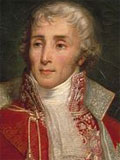
 |
Joseph Fouché
b. 27 May 1760 (?), Pellerin, near Nantes, France [1]
d. 25/26 Dec 1820, Trieste |
| Title: |
Président de la Commission de gouvernement (President of the Commission of Government) |
| Term: |
23 Jun 1815 - 7 Jul 1815 |
| Chronology: |
22 Jun 1815, elected a member of the Commission of Government, session of the Chambre des représentants (Chamber of the Representatives) [2] |
|
23 Jun 1815, elected President of the Commission of Government, inaugural meeting of the Commission of Government, Palais des Tuileries, Paris [3] |
|
7 Jul 1815, collective resignation of the Commission of Government communicated to the Chamber of Representatives, acknowledged [4] |
| Names/titles: |
Comte de Fouché, comte de l'Empire (count of Fouché, count of the Empire) [from 24 Apr 1808]; duc d'Otrante (duke of Otranto) [from 15 Aug 1809] |
| Biography: |
| Son of the captain of a merchant vessel; was educated at the collège of the Oratorians at Nantes and Paris; worked as a teacher at the collèges of Niort (1782), Saumur (1783), Vendôme (1784), Juilly (1787), Arras (1788); was a founder of a patriotic association in Nantes and a member of the Jacobin club; elected deputy from Loire-Inférieure to the Convention nationale (National Convention) (1792-1795); voted for death sentence in the trial of King Louis XVI; was an initiator of the atheistic movement aimed at the extinction of Christianity in France; assisted Jean-Marie Collot d'Herbois in the ruthless massacre of the counterrevolutionaries in Lyon (1793); excluded from the Jacobin Club (1794) after a split with Maximilien Robespierre; succeeded in engineering the fall of the Jacobin dictatorship (27 Jul 1794); was briefly arrested (9 Aug 1795) for his active role during the Reign of Terror; amnestied (26 Oct 1795) and returned to private life; offered services to Paul Barras; served as ambassador to the Cisalpine Republic (1798) and then to Batavian Republic (1799); appointed minister of police (20 Jun 1799 - 15 Sep 1802); helped Napoléon Bonaparte in preparation of the coup of 18 Brumaire, Year VIII (9 Nov 1799 - 10 Nov 1799); worked on organizing secret police, curbing the royalists and extreme Jacobins; was created member of the Sénat conservateur (15 Sep 1802); restored to the office of the minister of police (18 Jul 1804 - 3 Jun 1810) after he supported the proclamation of Napoléon as emperor; provisionally put in charge of the interior ministry (29 Jun 1809 - 12 Oct 1809); intrigued with the English against Napoléon; dismissed from his ministerial post and appointed governor general of Rome (1809); served as minister of police (20 Mar 1815 - 23 Jun 1815) during the Cent-Jours (Hundred Days); nominated a peer of France (2 Jun 1815); following the abdication of Napoléon, was elected to the Commission of Government (22 Jun 1815); served as president of the Commission (23 Jun 1815 - 7 Jul 1815); while ostensibly working for the recognition of Napoléon II, facilitated the return of the Bourbons; appointed minister of police (9 Jul 1815 - 24 Sep 1815); was elected to the Chambre des députés [Chamber of Deputies] (1815-1816); sent as ambassador to Saxony (1815); proscribed as a regicide (1816) and died in exile. |
| Biographical sources: Buisson (1968): "Fouché, duc d'Otrante", by Henry Buisson (Panorama, 1968); Madelin (1903): "Fouché, 1759-1820", by Louis Madelin (Paris: Plon, 1903); Dictionnaire des parlementaires français 1789-1889; Bulletin des lois, 4e série, Tome Onzième, pp. 167-169, N° 247, n° 4767: Lettres-Patentes qui confèrent le Titre de Duc à M. le Comte Fouché, Ministre de la Police générale. |
| Elections: |
| Candidate |
Votes
(22 Jun 1815, Chamber of Representatives) |
| 1st round |
2nd round |
| votes cast |
511 |
504 |
| absolute majority |
256 |
253 |
| Lazare-Nicolas-Marguerite Carnot |
324 |
- |
| Joseph Fouché duc d'Otrante |
293 |
- |
| Paul, comte Grenier |
204 |
330 |
| Marie-Joseph-Paul-Roch-Yves-Gilbert du Motier, marquis de La Fayette |
142 |
- |
| Jacques-Etienne-Joseph-Alexandre Macdonald, duc de Tarente |
137 |
- |
| Pierre-François Flaugergues |
46 |
- |
| Charles-Joseph-Mathieu Lambrechts |
42 |
- |
| Candidate |
Votes (23 Jun 1815, Chamber of Peers) |
| 2nd round |
3rd round |
| votes cast |
70 |
68 |
| Armand-Augustin-Louis de Caulaincourt, duc de Vicence |
52 |
- |
| Nicolas-Marie, baron de Quinette de Rochemont |
- |
48 |
|
| Source of electoral results: Archives parlementaires - Série 2, 14:510, 14:518.
|
| |
| [1] |
The date of birth is among the most disputable. Buisson (1968, pp. 48, 561) counted 13 dates given by 38 different authors: "Car l'énigme Fouché commence avec la date de naissance du personnage. Prenons trente-huit ouvrages, ils donnent treize dates de naissance différentes s'échelonnant de 1748 à 1769, en citant d'ailleurs plusieurs communes... Treize dates de naissance de Fouché sont données par 38 auteurs..." Since the authenticity of his records of birth and baptism was repeatedly criticised, the most compelling evidence might be the record of his admission to the collège of the Oratorians in Paris: "Le confrére J. Fouché, tonsuré, natif de Nantes, né le 27 mai 1760 de feu Joseph Fouché, capitaine au cabotage, et de Marie-Adélaïde Croizet, ses père et mère, a fait ses études d'humanités et de philosophie à notre collège de Nantes, est entré à l'Institution le 21 novembre et a été admis le 7 décembre." This document was published in Madelin (1903, 1:5). Madelin himself believed that Fouché was born 21 May 1759 on the ground of evidence found in a copy of his baptismal record. |
| [2] |
Archives parlementaires - Série 2, 14:518. |
| [3] |
Bulletin des lois, 6e série, Tome unique, p. 279, N° 38, n° 275: Arrêté par lequel la Commission du Gouvernement se constitue sous la présidence de M. le Duc d'Otrante. |
| [4] |
Archives parlementaires - Série 2, 14:620. |
|
Image: portrait by Claude Dubufe. |
