 |
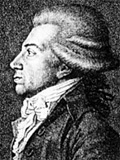
Bertrand Barère, dit Barère de Vieuzac
b. 10 Sep 1755, Tarbes, Hautes-Pyrénées [1]
d. 13 Jan 1841, Tarbes, Hautes-Pyrénées |
| Title: |
Président de la Convention nationale (President of the National Convention) |
| Term: |
29 Nov 1792 - 13 Dec 1792 |
| Chronology: |
29 Nov 1792,
elected, session of the Convention, Salle du Manège, Paris [2] |
|
30 Nov 1792,
assumed the chair, session of the Convention, Salle du Manège, Paris [3] |
|
13 Dec 1792,
ceased to exercise the functions of office upon the election of a successor [4] |
| Names/titles: |
Known in exile as: de Roquefeuille [from 1816] |
| Biography: |
| Studied law at the University of Toulouse (1770-1775); was admitted to the bar and sworn in (8 Jul 1775) as an avocat before the Parlement of Toulouse where he earned considerable reputation; served as senior counselor of the sénéchaussée of Bigorre (from 7 Nov 1776); traveled to Paris (1788), where became acquainted with liberal ideas; elected (23 Apr 1789) a representative of the Third Estate of Bigorre to the États-Généraux (Estates-General); served as a deputy of the Assemblée nationale (National Assembly) (1789-1791); sided with moderate liberals; joined the Jacobin Club (1789); published a newspaper, Le Point du Jour (1789-1791); was nominated a judge of the court of cassation of Hautes-Pyrénées (1791-1792); elected to the Convention nationale (National Convention) (1792-1794) by the départements of Hautes-Pyrénées and Seine-et-Oise, opted for Hautes-Pyrénées; served as President of the National Convention (29 Nov 1792 - 13 Dec 1792); voted for the death sentence in the trial of King Louis XVI; was elected a member of the Comité de salut public (Committee of Public Safety) (7 Apr 1793 - 1 Sep 1794) and emerged as one of the committee's most influential members; occupied himself with foreign affairs, military affairs, navy and public instruction, preparing more than 150 reports on behalf of the committee; was involved in the most notorious acts of revolutionary terror; following the coup of 9 Thermidor, Year II (27 Jul 1794), was condemned to exile along with Jean-Marie Collot d'Herbois and Jacques-Nicolas Billaud-Varenne; sent to the Isle of Oléron and later was moved to the prison of Saintes; during his transportation to Rochefort, he escaped to Bordeaux where he lived in concealment; was elected to the Conseil des Cinq-Cents (Council of Five Hundred) (14 Apr 1797) as a representative of Hautes-Pyrénées, but was not allowed to take his seat; granted amnesty (1799) and was made a reporter of public opinion (1803); his candidacy for membership in the Corps législatif was twice rejected by the Sénat in 1805 and 1810; elected to the Chambre des représentants (Chamber of Representatives) during the Hundred Days (Cent Jours); banished as a regicide (1815) and left Paris in 1816; lived in the Kingdom of the Netherlands; returned to France in 1830; was elected to the general council of Hautes-Pyrénées (1833-1840). |
| Biographical sources: Dictionnaire des parlementaires français 1789-1889, 1:167-168;
Dictionnaire des Conventionnels, 23-29; "Bertrand Barère: la voix de la Révolution", by Jean-Pierre Thomas (Paris: Desjonquères, 1989). |
| Elections: |
| Candidate |
Votes (29 Nov 1792) |
| Bertrand Barère de Vieuzac |
219 |
| voters |
310 |
|
| Source of electoral results: Archives parlementaires - Série 1, 53:673;
Procès-verbal de la Convention nationale, 3:392.
|
| |
| [1] |
"Bertrand Barère: la voix de la Révolution", op. cit., 328: "Bertrand Barère, fils legitimé de Maître Jean Barère, Procureur à la Cour du Sénéchal de Bigorre et de demoiselle Catherine Marrast de Nays est né en la paroisse Saint-Jean de cette ville le 10 septembre de l'an 1755 et a été baptisé par nous, archiprêtre soussigné." |
| [2] |
Archives parlementaires - Série 1, 53:673;
Procès-verbal de la Convention nationale, 3:392. |
| [3] |
Archives parlementaires - Série 1, 53:674. |
| [4] |
Archives parlementaires - Série 1, 55:43-44;
Procès-verbal de la Convention nationale, 4:218. |
