 |
Charles II
b. 29 May/8 Jun 1630, London
d. 6/16 Feb 1685, London |
| Title: |
Dei gratia Anglie Scotie Francie et Hibernie Rex, Fidei Defensor, etc. = By the grace of God, King of England, Scotland, France and Ireland, Defender of the Faith, etc. (see other style in non-statutory use) |
| Term: |
6/16 Aug 1651 - 15/25 Oct 1651 |
| |
30 Jan/9 Feb 1649, succeeded to the titles after the death of his predecessor, Charles I |
| |
6/16 Aug 1651, entered the territory of England and was proclaimed king near Carlisle, Cumberland [1] |
| |
15/25 Oct 1651, left national territory at Shoreham-by-Sea, near Brighton, East Sussex [2] |
| Term: |
8/18 May 1660 - 6/16 Feb 1685 |
| Chronology: |
8/18 May 1660, publicly proclaimed to have been king since 30 Jan/9 Feb 1649 in Westminster and London (regnal years counted from 30 Jan/9 Feb 1649) [3][4] |
| |
25 May/4 Jun 1660, resumed the exercise of royal authority upon entering the territory of England (arrived in London 29 May/8 Jun 1660) [5] |
| |
23 Apr/3 May 1661, crowned, Westminster Abbey, Westminster, England [6] |
| |
6/16 Feb 1685, died |
| Names/titles: |
Baptised (27 Jun/7 Jul 1630): Charles; private name: Charles Stuart; Gaelic name: Teàrlach; Duke of Cornwall [29 May/8 Jun 1630 - 30 Jan/9 Feb 1649]; Duke of Rothesay [29 May/8 Jun 1630 - 30 Jan/9 Feb 1649]; Earl of Carrick [29 May/8 Jun 1630 - 30 Jan/9 Feb 1649]; Prince of Wales, Earl of Chester [from c. 1638/1641] |
| |
Dei gratia Scotie Anglie Francie et Hibernie Rex, Fidei Defensor, etc. = By the grace of God, King of Scotland, England, France and Ireland, Defender of the Faith, etc. as Charles II [30 Jan/9 Feb 1649 - 6/16 Feb 1685, continued as title holder in the period when he was absent and/or not recognised in Scotland] |
| Biography: |
| Second and eldest surviving son of Charles I and Henrietta Maria of France; accompanied his father during the Civil War and was made royal bodyguard captain; appointed Generalissimo of all his father's forces (1645); retired to the Scilly islands and then to Jersey (1646); moved to France and finally settled in the Hague, Netherlands; was proclaimed king in Scotland (5/15 Feb 1649) and Jersey (16/26 Feb 1649) following the execution of his father sentenced to death by the court appointed by the Commons of England; staying in exile in the Netherlands, he signed the Treaty of Breda (1/11 May 1650) with the Covenanter faction, promising to impose Presbyterianism as national religion; arrived to the mouth of the Spey River 23 Jun/3 Jul 1650 and landed in Scotland 24 Jun/4 Jul 1650, relying on the support of the Covenanter army; was defeated by the Parliamentary army under Oliver Cromwell at Dunbar (3/13 Sep 1650); crossed the border of England and was proclaimed king 6/16 Aug 1651 near Carlisle; suffered ultimate defeat at Worcester (3/13 Sep 1651) and was forced to flee from England on 15/25 Oct 1651 (surrender of the last Scottish castle still holding out for Charles II was accepted on 26 May/5 Jun 1652, while the Scottish Crown Regalia were smuggled out of the castle and hidden); lived mostly in the Netherlands; during political crisis in the Commonwealth, issued the Declaration of Breda (4/14 Apr 1660), expressing his willingness to settle all disputed issues with the Parliament of England; after the Convention Parliament agreed to restoration, he was publicly proclaimed king (8/18 May 1660); landed at Dover (25 May/4 Jun 1660), reaching London on 29 May/8 Jun 1660; the early years of Charles's reign saw an appalling plague which hit the country in 1665 and the Great Fire of London in 1666; his foreign policy was a wavering balance of alliances with France and the Dutch in turn; the second Dutch war of 1665 proved to be a failure; in 1667, he dismissed his Lord Chancellor, the Earl of Clarendon, who was succeeded by a series of ministerial combinations, the first of which was that of Clifford, Ashley, Buckingham, Arlington and Lauderdale (whose initials formed the nickname Cabal); assented to the Test Act (1673) which excluded Roman Catholics from both Houses of Parliament; Parliament's reaction to the Popish Plot of 1678 was to impeach Lord Treasurer Danby and to present a bill to exclude Prince James from the succession; in 1680-81 Charles dissolved three Parliaments which had all tried to introduce Exclusion Bills. |
| Biographical sources: "King Charles II", by Antonia Fraser (London: Weidenfeld and Nicolson, 1979); "The Restoration of Charles II 1658-1660", by Godfrey Davis (Huntington Library, San Marino, CA, 1955); "Personal History of King Charles the Second: From His Landing in Scotland, on June 23, 1650, Till His Escape Out of England, October 15, 1651. With an Outline of His Life Immediately Before and After These Dates", by Charles Jobson Lyon (Edinburgh: Tomas George Stevenson, 1851) (web site) |
| |
| [1] |
"Personal History of King Charles the Second", op. cit., pp. 208-209. |
| [2] |
"Personal History of King Charles the Second", op. cit., pp. 284-285. |
| [3] |
Commons Journal, 8:16-18; Lords Journal, 11:18-19. |
| [4] |
After the Convention Parliament reached the decision to recall Charles II, the House of Commons passed two resolutions on 5/15 May 1660 and 8/18 May 1660 that all proceedings involving the use of the Great Seal of England were to be in the king's name from 5/15 May 1660 (Commons Journal, 8:12-14, 8:16-18), but no concurrent resolution of the House of Lords was obtained. The House of Commons also resolved 7/17 May 1660 that "Ministers throughout the Kingdom of England, Scotland, and Ireland, Dominion of Wales, and Town of Berwick upon Tweed, be, and are hereby required and enjoined, publickly to pray for the King's Majesty, by the Name of Our Sovereign Lord Charles the Second, by the Grace of God, King of England, Scotland, France, and Ireland, Defender of the Faith, &c." (Commons Journal, 8:14-16) Since Charles ceremonially entered London on 29 May/8 Jun 1660, this date was designated by an Act to be a "perpetual anniversary of thanksgiving". Therefore, Charles' 12th regnal year ran from 29 May/8 Jun 1660 to 29 Jan/8 Feb 1661, although the declaration of Breda had been dated "4/14 Apr 1660... in the twelfth year of our reign". |
| [5] |
Commons Journal, 8:48-49; Lords Journal, 11:45-46. |
| [6] |
"Festa Georgiana, or the Gentries & Countries Joy for the Coronation of the King on St. Georges Day" (London, 1661). |
| |
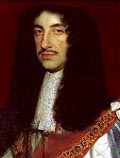
Image: portrait of King Charles II in garter robes by John Michael Wright or studio, c. 1660-1665. |
