 |
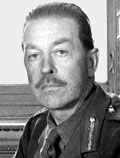
Harold Rupert Leofric George Alexander
b. 10 Dec 1891, London, England
d. 16 Jun 1969, Slough, Buckinghamshire, England |
| Title: |
Governor General and Commander-in-Chief of the Dominion of Canada = Gouverneur général et Commandant en chef du Dominion du Canada |
| Term: |
12 Apr 1946 - 28 Jan 1952 |
| Chronology: |
21 Mar 1946,
appointed by Commission under the Royal Sign Manual and Signet [1] |
| |
12 Apr 1946, took an oath of allegiance and an oath of office as Governor-General and Commander-in-Chief of Canada, public ceremony, Senate Chamber, Parliament Buildings, Ottawa, Ontario [2] |
| |
28 Jan 1952, appointment terminated by Letters Patent under Royal Hand and Great Seal of Canada of 16 Jan 1952, effective 28 Jan 1952 [3] |
| Names/titles: |
Sir Harold Rupert Leofric George Alexander (from 1 Jan 1942, Knight Commander of the Most Honourable Order of the Bath); nobility titles (all conferred): Viscount Alexander of Tunis, of Errigal in the County of Donegal (from 1 Mar 1946), Earl Alexander of Tunis, Baron Rideau, of Ottawa, and of Castle Derg in the County of Tyrone (from 14 Mar 1952) [4] |
| Biography: |
| Third son of James Alexander, 4th Earl of Caledon; was left fatherless at an early age, his older brothers assuming the responsibility for his upbringing; educated at Hawtreys and Harrow School; attended the Royal Military College Sandhurst; commissioned second lieutenant in the Irish Guards (1911); promoted to lieutenant (1912) and formed part of the original British Expeditionary Force when World War I began; was wounded twice and received several awards during the war; promoted to captain (1915), major (1917); made acting lieutenant-colonel (1917); led the Baltic German Landeswehr in military conflict in Latvia (1919); promoted to substantive lieutenant-colonel (1922); attended Staff College, Camberley (1926-1928); promoted to colonel (1928); commandant of the Irish Guards Regiment and Regimental District (1928-1930); attended the Imperial Defence College (1930-1931); appointed an aide-de-camp to King Edward VIII (1936); promoted to major-general (1937), being the youngest of this rank in the British army at that time; led the First Division in France in 1940 and the rearguard at Dunkirk; promoted to lieutenant-general (1940), general (1942); directed the British-Chinese army's retreat from the Japanese invasion of Burma (1942); served as commander-in-chief of the Middle East Command (1942-1943); commanded 18th and 15th Army Groups (1943-1944); promoted to field marshal (5 Dec 1944, backdated to 4 Jun 1944) after the capture of Rome; appointed Supreme Commander of the Allied Forces Headquarters; imposed terms of unconditional surrender on the German armies in south-western Europe (29 Apr 1945); was slated to become chief of the Imperial General Staff after the war, but Winston Churchill insisted on his appointment as Governor General of Canada (12 Apr 1946 - 28 Jan 1952); made a strong public impression as governor general; received all of king's powers and authorities in respect of Canada in accordance with a Letters Patent of King George VI (effective 1 Oct 1947); paid a visit to Newfoundland when it entered Canadian confederation in 1949; was relieved of his office as governor general at his own request to join the British cabinet (1952); appointed and sworn in as a member of Privy Council for Canada (29 Jan 1952); on his return to England, he was sworn in as a member of U.K. Privy Council (29 Feb 1952) and served as minister of defence in the Churchill's third government (29 Feb 1952 - 18 Oct 1954). |
| Biographical sources: The Canadian encyclopedia: year 2000 edition. McClelland & Stewart Inc., Toronto; The Times, Royal Edition, Tuesday June 17 1969, No. 57,588, pp. 1, 10 (obituary) |
| |
| [1] |
The full text of Royal Commission was not published in Canada Gazette, but the Proclamation on assumption of the office of 12 Apr 1946 refers to "Commission under His Royal Manual Sign and Signet bearing date at the Court of St. James's the twenty-first day of March, 1946" [Canada Gazette, No. 7, Extra, 12 Apr 1946, p. (1)]. |
| [2] |
Canada Gazette, No. 7, Extra, 12 Apr 1946, pp. (1)-2; Globe and Mail, Metropolitan Edition, No. 30,055, 13 Apr 1946, pp. (1)-2. |
| [3] |
Canada Gazette, No. 5, 2 Feb 1952, pp. 279, 303. |
| [4] |
Supplement to The London Gazette of Tuesday, the 30th of December, 1941, Numb 35399, Thursday, 1 January, 1942, p. 3; Supplement to The London Gazette of Friday, the 28th of December, 1945, Numb 37407, Tuesday, 1 January, 1946, p. 3; The London Gazette, Numb. 37491, Tuesday, 5 March, 1946, p. 1241; The London Gazette, Numb. 39491, Friday, 14 March, 1952, p. 1468. |
| |
Image: photograph, 29 Jan 1952. |
